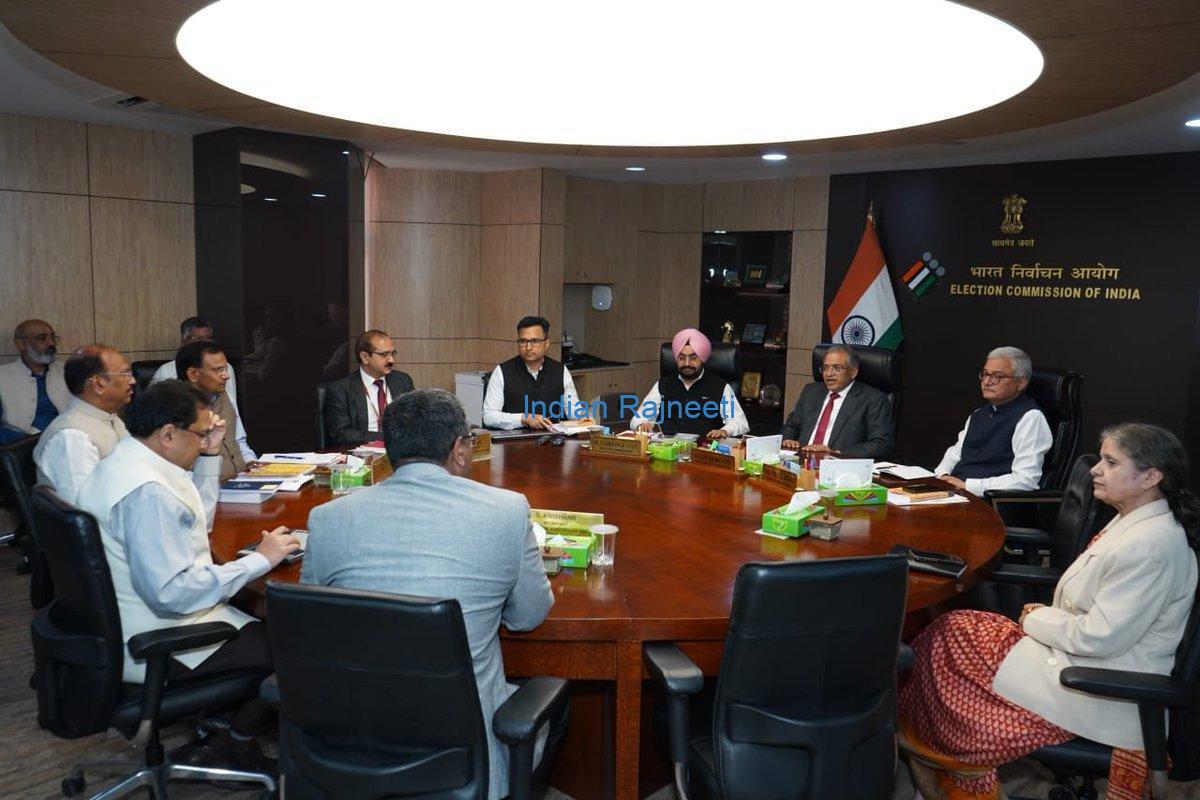
Chief Election Commissioner Gyanesh Kumar with Election Commissioners Sukhbir Singh Sandhu and Vivek Joshi at the Election Commission of India.
Reported differences within the three-member Election Commission of India (ECI) have emerged as a major political issue following an investigation that said Election Commissioners Sukhbir Singh Sandhu and Vivek Joshi had formally raised objections on at least 14 occasions over a 10-month period regarding decisions and administrative directions connected with electoral-roll management and the Special Intensive Revision (SIR) process.
According to the report, the objections concerned several aspects of the Election Commission’s functioning, including changes to Form 6, procedures relating to the addition and deletion of voters, the handling of electoral-roll data and the centralisation of controls over voter databases. The report said the two commissioners had, on some occasions, objected that decisions or instructions had been issued without their prior knowledge.
The controversy is closely linked to the Special Intensive Revision (SIR) of electoral rolls. The exercise began in Bihar in June 2025 and was subsequently extended to other parts of the country. The Indian Express reported that more than 13 crore names had been struck off draft electoral rolls across 30 States and Union Territories during the wider revision exercise, making the process a major subject of public and political debate.
The reported objections have focused on issues such as voter registration procedures, deletion and restoration of names, electoral-roll software and access to voter databases. One area highlighted in the reporting was the centralisation of controls over the ERONet system in Delhi. The two commissioners reportedly expressed concerns about how access to electoral data and related systems was being managed.
The Election Commission has rejected the interpretation that the reported exchanges represent an institutional breakdown. ECI officials said that differences of opinion, observations and questions raised during internal deliberations are part of the normal functioning of a multi-member constitutional institution. The Commission maintained that important decisions, including the SIR exercise, ultimately had the approval of all three commissioners.
The issue has nevertheless triggered a sharp political response from Opposition parties, which have questioned the transparency of the Election Commission’s decision-making process and demanded greater scrutiny of the role of Chief Election Commissioner Gyanesh Kumar. Opposition leaders have linked the controversy to their broader concerns about the SIR exercise, voter-list changes and electoral transparency.
The Bharatiya Janata Party (BJP) has defended the Election Commission. BJP spokesperson Sambit Patra argued that disagreements among Election Commissioners during official deliberations should not automatically be viewed as evidence of institutional dysfunction. He said that discussion, disagreement and eventual consensus demonstrate that the constitutional body is functioning through a democratic deliberative process.
Patra also stressed that the final decisions relating to the SIR exercise were unanimous. He challenged the Opposition’s interpretation of the reported objections and said that the existence of internal discussions did not establish that the Election Commission was being controlled by one individual.
The controversy has therefore produced two contrasting interpretations. The Opposition argues that the reported objections raise questions about transparency, consultation and institutional independence, while the BJP and the Election Commission maintain that internal deliberation and differing views are normal features of a constitutional body and that the final decisions were taken according to established procedures.
At the centre of the debate is the question of how decisions affecting India’s electoral rolls and voter-registration system are discussed, recorded and implemented within the Election Commission. The reported objections provide a documented account of disagreements among commissioners, but the significance and interpretation of those disagreements remain contested by the political parties and the Election Commission itself.
The controversy is expected to remain connected to the wider national debate over electoral-roll revisions, SIR, voter rights, election transparency and the independence of constitutional institutions. For voters, the central issue is how electoral-roll changes are carried out, how objections and appeals are handled, and what safeguards are in place to ensure that eligible citizens remain able to participate in elections.
As of September 24, 2026, the Election Commission maintains that its major decisions were taken unanimously, while Opposition parties continue to demand greater scrutiny of the reported internal objections and the functioning of the poll panel. The dispute therefore remains an important political and institutional issue surrounding India’s electoral process.
The political dialogue between Ladakh representatives and the Centre remains significant as the Union Territory…
The Supreme Court of India is currently dealing with several matters that have significant constitutional…
The Special Intensive Revision (SIR) of electoral rolls has come under increased scrutiny amid questions…
Opposition parties have stepped up demands for action against Chief Election Commissioner Gyanesh Kumar following…
Political activity has intensified in West Bengal ahead of the upcoming Assembly bypolls in Nandigram…
The Election Commission of India (ECI) has announced the schedule for elections to 12 Rajya…