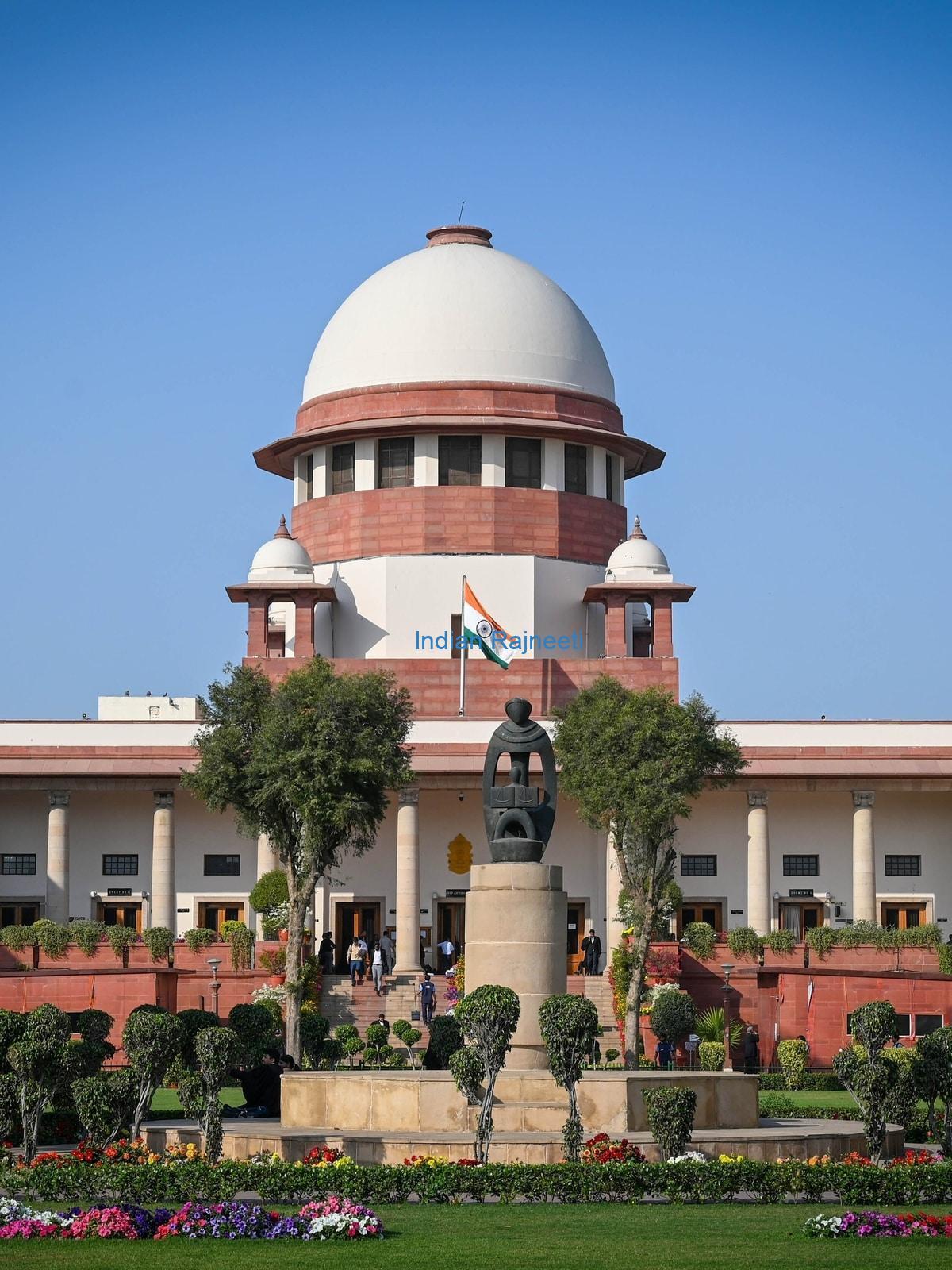
The Supreme Court of India in New Delhi, where several significant constitutional and political matters are being considered.
The Supreme Court of India is currently dealing with several matters that have significant constitutional and political implications, including a challenge to the 2023 law governing the appointment of the Chief Election Commissioner (CEC) and Election Commissioners, questions surrounding appointments to the higher judiciary, and petitions concerning the delayed decision on the disqualification of 20 rebel Trinamool Congress (TMC) Lok Sabha MPs.
One of the most important developments concerns the Election Commission appointment law. On September 23, 2026, a two-judge Supreme Court Bench comprising Justice Dipankar Datta and Justice Satish Chandra Sharma delivered differing views on whether challenges to the 2023 appointment law should be referred to a larger Constitution Bench. The matter was ultimately placed before Chief Justice of India Surya Kant for constitution of an appropriate larger bench, with the issue expected to be examined by a five-judge Constitution Bench.
The dispute concerns the Chief Election Commissioner and Other Election Commissioners (Appointment, Conditions of Service and Term of Office) Act, 2023. The law replaced the Chief Justice of India with a Union Cabinet Minister nominated by the Prime Minister on the three-member selection committee consisting of the Prime Minister, the Leader of Opposition in the Lok Sabha and the nominated Union Cabinet Minister. Petitioners have challenged the constitutional validity of this arrangement.
The legal background goes back to the Supreme Court’s Anoop Baranwal judgment of 2023. In that case, the Court had prescribed an interim selection mechanism involving the Prime Minister, Leader of Opposition and Chief Justice of India, until Parliament enacted a law governing appointments under Article 324 of the Constitution. Parliament subsequently enacted the 2023 legislation, leading to the present constitutional challenge.
The September 23 proceedings produced a significant judicial disagreement. Justice Dipankar Datta did not agree that a larger bench was necessary at that stage, while Justice Satish Chandra Sharma took the view that the matter warranted consideration by a Constitution Bench. Since the judges differed, the matter was placed before the CJI so that an appropriately constituted larger bench could consider the constitutional questions.
The case raises broader constitutional questions about Article 324, Parliament’s authority to establish a statutory framework for appointments to the Election Commission, and the safeguards required to maintain public confidence in an institution responsible for conducting elections. The eventual Constitution Bench will have to examine the legal challenge and the relationship between legislative authority and the constitutional requirement of an independent election administration.
Another important area concerns appointments to India’s higher judiciary. The Supreme Court Collegium has continued to make recommendations for appointments and transfers involving the High Courts. On September 23, 2026, the Supreme Court’s official Collegium records included recommendations concerning the appointment of Additional Judges as Permanent Judges in the Andhra Pradesh, Kerala, Uttarakhand and Gauhati High Courts. Earlier in September, recommendations were also made for judicial officers to become judges of the Delhi, Karnataka, Jharkhand and Jammu & Kashmir and Ladakh High Courts.
The judicial appointment process operates through a constitutional and administrative framework involving the Supreme Court Collegium, the Union Government and other constitutional authorities. A 2026 government document states that appointments to the Supreme Court and High Courts are governed by Articles 124, 217 and 224 of the Constitution, together with the Memorandum of Procedure. It also reported that, as of March 23, 2026, 319 High Court judge positions were vacant against a sanctioned strength of 1,122.
Questions over the interaction between the judiciary and executive have also surfaced in connection with individual High Court appointments. For example, the appointment of Justice Ashwani Kumar Mishra as Chief Justice of the Punjab and Haryana High Court led to disagreement over the role of the state government in the appointment process. The episode highlighted continuing questions about consultation under the Memorandum of Procedure and the respective roles of the Centre, state governments and the Supreme Court Collegium.
A third politically significant matter involves the 20 rebel TMC Lok Sabha MPs. The Trinamool Congress approached the Supreme Court seeking an expedited decision on petitions seeking their disqualification. The petitions were filed after the MPs were alleged to have left the TMC faction and joined the Nationalist Citizens Party of India (NCPI). The issue is connected with the Tenth Schedule of the Constitution, commonly known as the anti-defection law.
The Supreme Court has questioned the delay in the proceedings before Lok Sabha Speaker Om Birla. During a September 23 hearing, a Bench comprising Chief Justice Surya Kant, Justice Joymalya Bagchi and Justice V. Mohana considered the delay in deciding the disqualification petitions. Justice Bagchi observed that the fact that approximately three months had elapsed was significant in the context of the pending proceedings.
Following the Supreme Court proceedings, the Lok Sabha Secretariat issued notices to the 20 MPs, asking them to respond to the disqualification petitions. The notices followed the Supreme Court’s consideration of the request for an expedited decision. The MPs’ responses form part of the proceedings before the Speaker, who is the authority handling the disqualification petitions under the constitutional framework.
The disqualification dispute has broader implications because the anti-defection law is intended to regulate changes in party allegiance by legislators. At the same time, questions about the timing of decisions in disqualification cases have repeatedly reached the courts, particularly where delays can affect the functioning of legislatures and representation.
Taken together, these cases place the Supreme Court at the centre of several important institutional questions. The Election Commission appointment case concerns how members of an independent constitutional body are selected; the judicial appointment issues concern the relationship between the Collegium and the executive; and the TMC MPs’ case concerns the constitutional process for deciding legislators’ disqualification petitions.
These matters are separate legal proceedings and should not be treated as one single case. However, they share a broader constitutional context involving institutional independence, separation of powers, accountability and the functioning of constitutional authorities.
As of September 24, 2026, the Election Commission appointment-law challenge is moving toward consideration by a larger Constitution Bench, the Supreme Court Collegium continues to process judicial appointments and transfers, and the proceedings concerning the 20 rebel TMC MPs remain linked to the Speaker’s decision-making process. The developments are being closely followed because their eventual outcomes could have implications for the functioning of India’s electoral institutions, higher judiciary and parliamentary anti-defection framework.
The political dialogue between Ladakh representatives and the Centre remains significant as the Union Territory…
The Special Intensive Revision (SIR) of electoral rolls has come under increased scrutiny amid questions…
Reported differences within the three-member Election Commission of India (ECI) have emerged as a major…
Opposition parties have stepped up demands for action against Chief Election Commissioner Gyanesh Kumar following…
Political activity has intensified in West Bengal ahead of the upcoming Assembly bypolls in Nandigram…
The Election Commission of India (ECI) has announced the schedule for elections to 12 Rajya…