Assembly Elections 2026: BJP's West Bengal Victory and TVK's Tamil Nadu Breakthrough Reshape State Politics
A significant year for state politics
The 2026 Assembly elections in five states and Union Territories became a major political event because they tested the strength of established parties and the ability of newer political forces to attract voters.
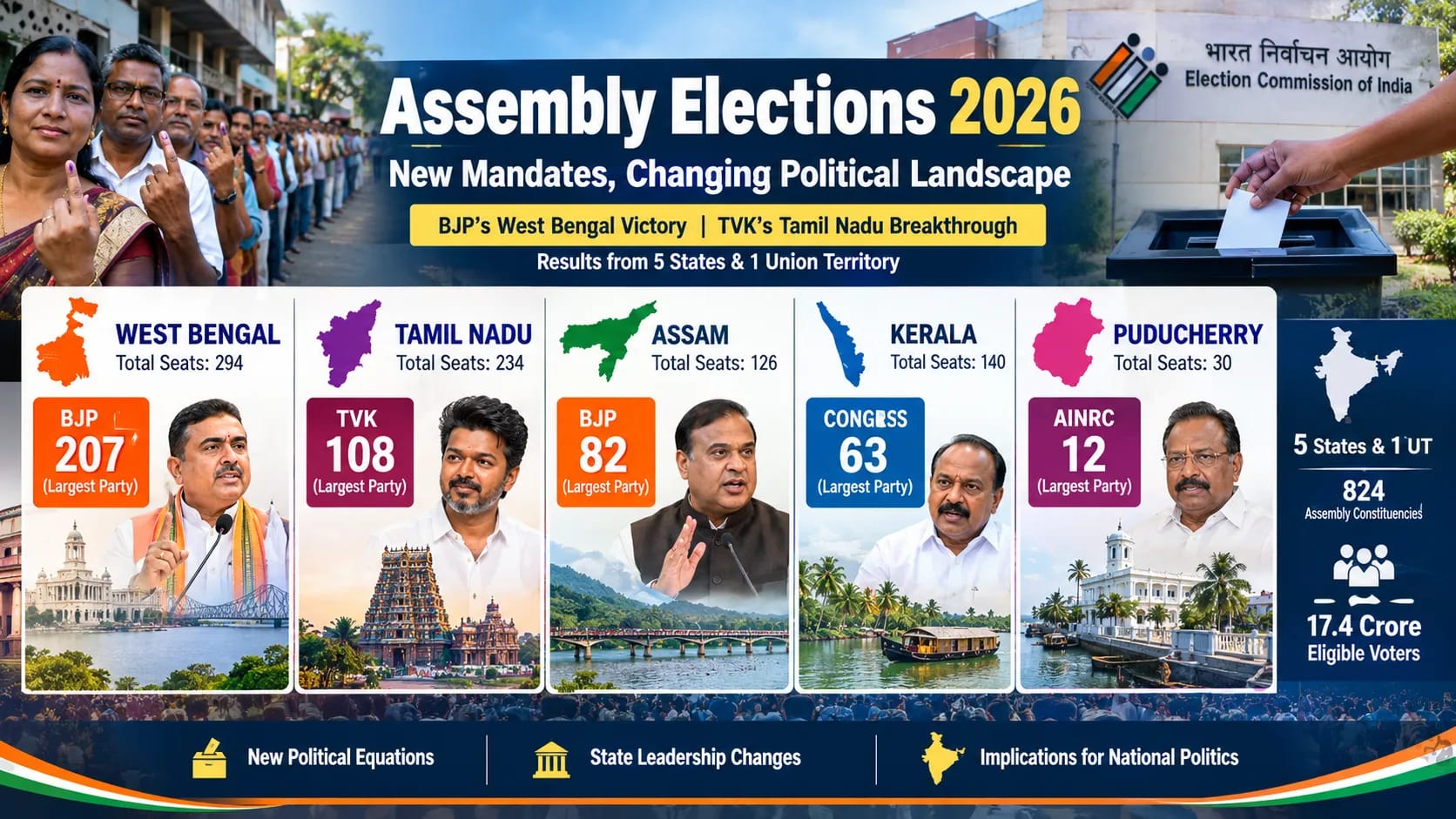
The Election Commission of India conducted general elections for the legislative assemblies of Assam, Kerala, Tamil Nadu, West Bengal and Puducherry. The electoral exercise covered 824 assembly constituencies across the five jurisdictions.
The results revealed contrasting political outcomes. In West Bengal, the BJP emerged as the largest party, while Tamilaga Vettri Kazhagam (TVK) recorded a major breakthrough in Tamil Nadu. Assam returned a strong BJP position, Kerala saw the Congress emerge as the largest party, and Puducherry's assembly results produced a varied party distribution.
These outcomes provide a basis for analysing party performance and regional political change. However, the ECI's published figures establish election results, not the reasons why every voter chose a particular party. Claims about voter motivation require additional evidence.
West Bengal: BJP wins 207 seats
West Bengal recorded one of the most consequential outcomes of the election cycle.
According to the ECI's published party-wise results, the BJP won 207 seats, while the All India Trinamool Congress (AITC) won 80. The Indian National Congress secured two seats, the Aam Janata Unnayan Party won two, and the CPI(M) and All India Secular Front won one each.
The results marked a major change in the state's legislative balance and placed the BJP in a strong position in the 294-member assembly.
Tamil Nadu: TVK wins 108 seats
Tamil Nadu's election produced a major breakthrough for Tamilaga Vettri Kazhagam, the party led by C. Joseph Vijay.
The ECI's published results show TVK winning 108 seats in the 234-member Assembly. The Dravida Munnetra Kazhagam (DMK) won 59 seats, while the All India Anna Dravida Munnetra Kazhagam (AIADMK) won 47. The Congress secured five seats, and other parties won the remaining seats.
The result changed the competitive landscape in a state where the DMK and AIADMK have historically been central to electoral politics.
For the DMK and AIADMK, the results create different strategic challenges. Both parties must assess their seat totals, alliances and constituency-level performance before deciding how to respond to the new political balance.
Assam: BJP remains the largest party
In Assam, the BJP won 82 of the 126 Assembly seats, according to the ECI's published results. The Indian National Congress won 19 seats, while the Bodoland People's Front and Asom Gana Parishad secured ten seats each.
The result places the BJP in a strong legislative position and gives the party a substantial base from which to pursue its state agenda.
For the opposition, the results make coordination and constituency-level strategy important subjects for future political planning.
Kerala: Congress emerges as the largest party
Kerala's Assembly results showed the Congress winning 63 seats in the 140-member legislature. The CPI(M) secured 26 seats and the Indian Union Muslim League won 22, according to the ECI's party-wise results.
The Congress result strengthened its legislative position, while the seat distribution among other parties reflected the continuing importance of coalition politics in Kerala.
For the parties forming or supporting the Congress-led United Democratic Front, the result creates an opportunity to pursue their programme through the state legislature.
Puducherry: A varied Assembly result
Puducherry's 30-member Assembly also produced a mixed distribution of seats.
The ECI's published figures show the All India N.R. Congress winning 12 seats, the DMK five and the BJP four. TVK won two seats, while the Congress, Latchiya Jananayaka Katchi and several other parties and independents shared the remaining seats.
What do these results mean for national politics?
The election results reveal different political trends across the five jurisdictions rather than a single uniform national pattern.
The BJP's performance in West Bengal and Assam strengthens its position in those state legislatures. TVK's success in Tamil Nadu introduces a major new force into the state's political competition. Kerala's result strengthens the Congress-led side, while Puducherry's distribution demonstrates the continuing relevance of alliances and smaller parties.
Conclusion
The 2026 Assembly elections produced substantial changes in the political balance of several states. The ECI's published results show the BJP winning 207 seats in West Bengal and TVK winning 108 in Tamil Nadu, alongside significant results in Assam, Kerala and Puducherry.
The political importance of these outcomes will ultimately depend on how the parties respond to the new legislative arithmetic and whether the incoming administrations deliver on their stated priorities.





Join the discussion
Comments (0)