36 Communities, One Manipur! CM Khemchand Singh's Bold Message Sparks a Bigger Debate on Political Representation and State Unity
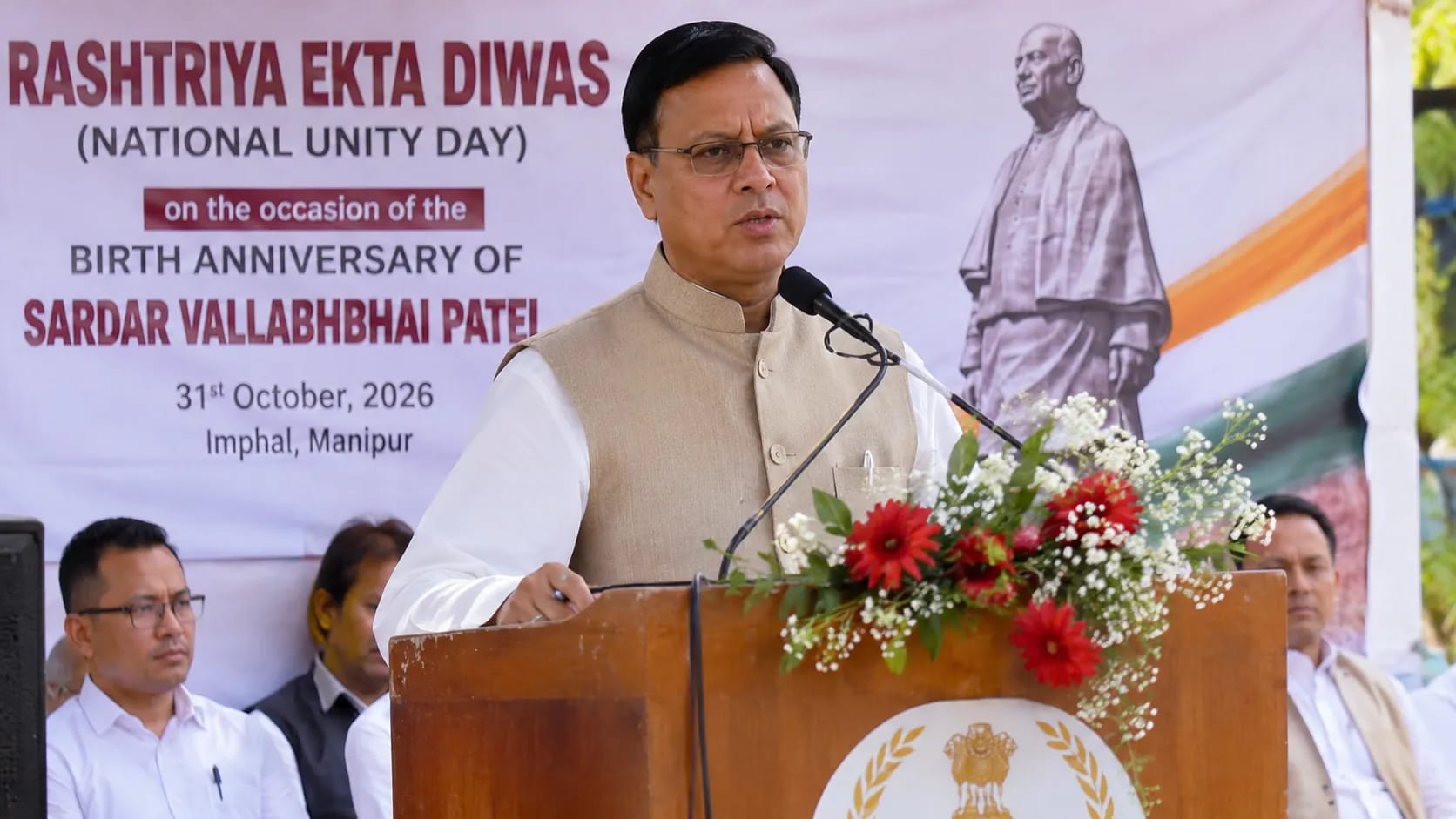
A strong political message from Imphal
Manipur Chief Minister Yumnam Khemchand Singh has placed unity and inclusive governance at the centre of political discussion after emphasising that the state belongs to all its 36 communities.
Addressing the Rashtriya Ekta Diwas programme on 31 October 2026 at the 1st Battalion Manipur Rifles Parade Ground in Imphal, the Chief Minister stressed that the state cannot be governed by prioritising the interests of any single community.
His statement carries particular political significance as Manipur continues to face the challenge of rebuilding confidence and strengthening relationships among its diverse communities.
The Chief Minister's message was delivered during the observance of the 151st birth anniversary of Sardar Vallabhbhai Patel, whose contribution to national integration is commemorated through National Unity Day.
The event was attended by Home Minister Govindas Konthoujam, MLAs, senior administrative officials, security representatives and police personnel.
Why the 36-community message matters
Manipur's social identity is shaped by diverse communities, each with its own cultural traditions, history and political concerns.
The Chief Minister's statement highlights an important governance principle: public institutions must work for the entire state.
In a diverse political environment, inclusive governance requires more than general assurances.
It requires fair access to public services, opportunities for participation and proper attention to the concerns of different communities.
The political challenge is to ensure that smaller communities are not overlooked while maintaining a common constitutional and democratic framework.
Proposed committee representing all 36 communities
An important related development is the Chief Minister's proposal to establish an integrity committee representing all 36 communities.
The proposal was discussed during a meeting with hill chiefs representing different tribes of Manipur on 24 October 2026.
During the interaction, the Chief Minister highlighted the importance of creating a platform where different communities could participate in discussions concerning peace, harmony and development.
He also indicated that consultations with former Rajya Sabha MP Maharaja Leishemba Sanajaoba and MLAs would be undertaken.
Political representation of smaller communities
The issue of representation is another important dimension of the Chief Minister's initiative.
Smaller communities may face difficulties in securing direct electoral representation because of their population size and geographical distribution.
The Chief Minister has reportedly discussed this concern and the need to examine ways of strengthening participation.
A committee representing different communities could provide an additional consultation mechanism.
Debate over a bicameral legislature
The Chief Minister has also referred to exploring a bicameral legislative structure for Manipur.
A bicameral legislature consists of two Houses. India's Parliament, for example, has the Lok Sabha and Rajya Sabha.
Some states also have legislative councils alongside their legislative assemblies.
The idea of examining a similar arrangement in Manipur raises important questions about democratic representation.
Peace and unity remain major responsibilities
The Chief Minister's message comes against the background of Manipur's continuing efforts to restore stability and public confidence.
The state needs sustained dialogue, effective administration and equal attention to the concerns of different communities.
Political statements alone cannot resolve longstanding disagreements.
The government must demonstrate that public institutions are accessible, grievances are addressed and development reaches different parts of the state.
Education, employment, healthcare, security and infrastructure are also important components of restoring public confidence.
What should the government do next?
The next important step is to clarify the proposed committee's structure.
The government should explain how representatives will be selected, how smaller communities will participate and what responsibilities the committee will have.
It should also clarify whether recommendations will be published and how follow-up action will be monitored.
Opposition parties and civil society organisations have an important role in examining these proposals. However, no unverified party reactions should be presented as fact.
Conclusion: One Manipur must mean equal participation
Chief Minister Yumnam Khemchand Singh's message during Rashtriya Ekta Diwas has brought the question of unity and representation back into the political spotlight.
His appeal that no single community should take priority over the state as a whole highlights the importance of inclusive governance.
Thirty-six communities, one shared state and one collective responsibility: protecting Manipur's unity through democratic participation and accountable leadership.
Join the discussion
Comments (0)