
Mahanadi Water Dispute: Odisha vs Chhattisgarh Intensifies as Amit Shah Steps In – Can Mohan Majhi Secure Odisha's Water Rights?
A river dispute that has become a major political issue
The Mahanadi water dispute is one of the most important inter-state resource disagreements involving Odisha.
For years, the river has remained at the centre of discussions about water-sharing rights, upstream construction activities, irrigation requirements and the future of agricultural development.
The disagreement between Odisha and Chhattisgarh is not simply a matter of administrative coordination. It directly affects farmers, rural communities, drinking water availability, industries and the management of major water infrastructure.
Amit Shah chairs October 1 high-level meeting
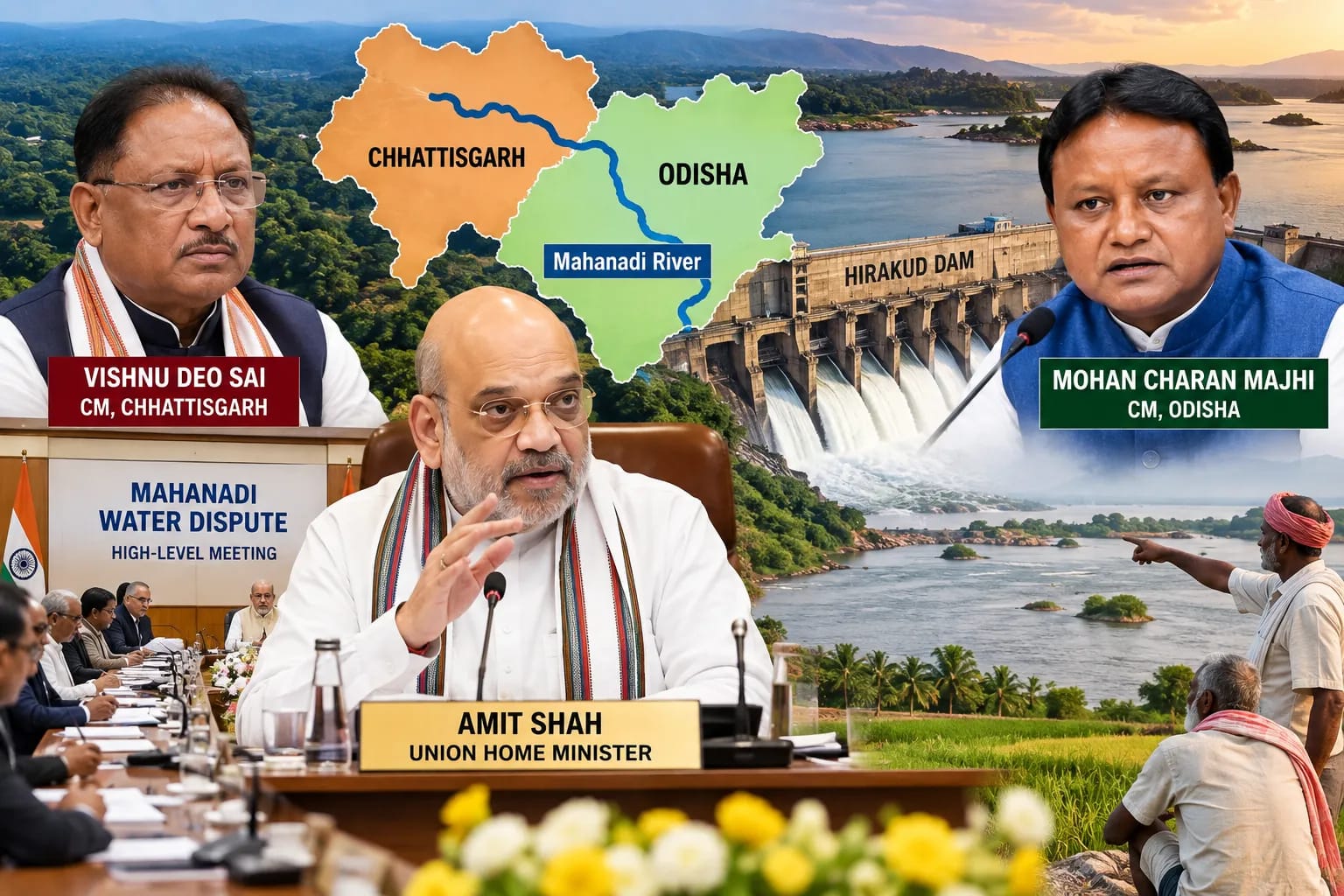
On October 1, 2026, Union Home Minister Amit Shah chaired a high-level meeting in New Delhi to facilitate a resolution to the long-standing Mahanadi water dispute.
The meeting involved Odisha Chief Minister Mohan Charan Majhi, Chhattisgarh Chief Minister Vishnu Deo Sai and Union Jal Shakti Minister C. R. Patil, along with senior officials.
The meeting was aimed at facilitating dialogue and finding a mutually acceptable solution.
It represented an important political effort because both states were involved in discussions under the Union government's mediation.
Why Odisha considers the dispute so important
The Mahanadi supports a large network of economic and social activities.
Its water is important for:
Agricultural irrigation and crop cultivation.
Drinking water requirements in several districts.
Industrial and economic activities.
Reservoir management and flood control.
Rural livelihoods and fisheries.
Long-term water security.
The Hirakud Dam is particularly important to Odisha's water-management system.
The reservoir provides water for irrigation and other purposes, while its management is also connected to flood-control requirements.
The dispute over upstream projects
A central concern in the dispute involves the construction and operation of projects in the upper reaches of the Mahanadi in Chhattisgarh.
Odisha has raised concerns about how upstream barrages and water-management structures could influence downstream water availability.
Chhattisgarh, on the other hand, has its own development and water requirements and has defended the importance of its projects.
BJD questions the Odisha government's approach
The dispute has also created a political debate within Odisha.
The Biju Janata Dal, now in opposition, has sought greater clarity regarding the negotiations.
The party has emphasised that Odisha's interests must not be compromised during discussions with Chhattisgarh.
BJD leaders have also called for transparency and wider consultation before the government finalises any important arrangement. One of the concerns raised by the opposition is whether the state government is sharing enough information with political representatives and the public about the negotiations.
BJP government faces a major responsibility
For Chief Minister Mohan Charan Majhi, the dispute presents an important test of governance.
The BJP government must demonstrate that its negotiations can deliver a practical solution while protecting Odisha's water requirements.
The challenge is particularly important because both Odisha and Chhattisgarh are governed by BJP-led governments.
Why the Central Water Commission matters
The Central Water Commission has an important technical role in discussions concerning the river.
Water-sharing disputes require scientific assessments of river flows, rainfall, storage, existing usage and future requirements.
The CWC's technical expertise can help both states understand the implications of different water-sharing proposals.
The Mahanadi Water Disputes Tribunal was constituted on March 12, 2018, following Odisha's request for adjudication under the Inter-State River Water Disputes Act, 1956.
The tribunal remains an important part of the dispute-resolution process.
What could a settlement mean for ordinary people?
A successful settlement could bring long-term benefits to both states.
For farmers in Odisha, greater clarity about water availability could improve agricultural planning.
For communities dependent on drinking water supplies, predictable water-management arrangements could reduce uncertainty.
For Chhattisgarh, an agreed framework could provide greater clarity regarding its own development and infrastructure projects.
What happens next?
The immediate priority is to examine the technical discussions and the progress made through the Central Water Commission.
Both states will need to identify the issues on which they agree and the areas where differences remain.
The Odisha government will also face pressure from the opposition to disclose the broad principles of its negotiating position.
The Mahanadi dispute is therefore entering a crucial phase.
The coming months will determine whether political dialogue can develop into a permanent water-sharing arrangement or whether the disagreement will continue through the tribunal process.


Join the discussion
Comments (0)