Manipur Political Storm! Representation, Ethnic Demands and Centre–State Relations Put Government Under Pressure
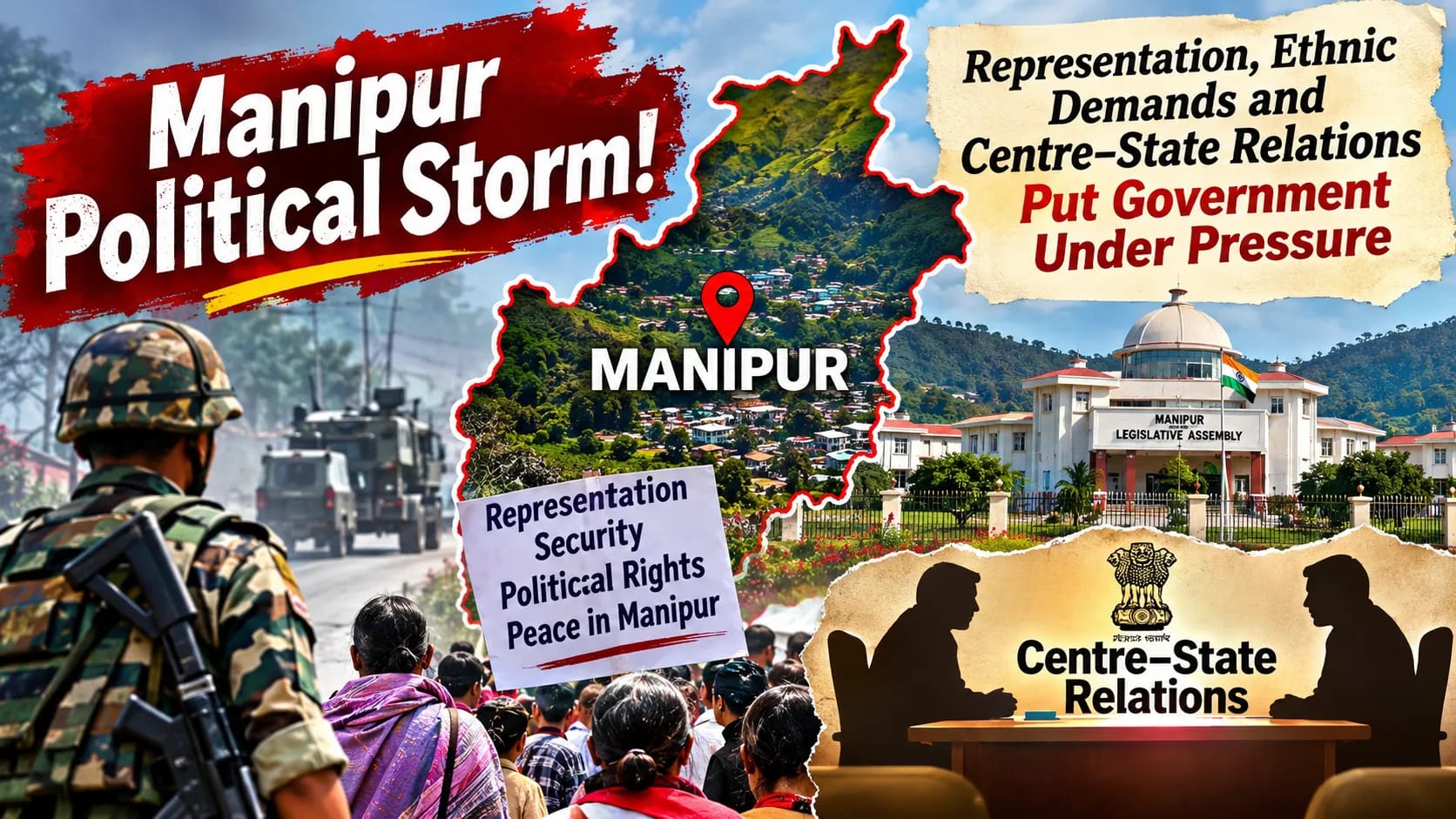
Introduction: Manipur's Political Future at a Critical Crossroads
Manipur is once again facing a crucial political test. More than three years after ethnic violence erupted in May 2023, the state's political landscape continues to be shaped by questions of representation, security, administrative stability and relations between the state government and the Centre.
The restoration of an elected government has brought back constitutional political processes, but it has not automatically resolved the deeper disagreements between communities and political stakeholders.
For political parties, the challenge is no longer limited to maintaining legislative strength. They must also demonstrate that the government can represent different communities, address legitimate concerns and establish a credible path towards lasting peace.
Political Representation Becomes a Major Challenge
Political representation remains one of the most sensitive issues in Manipur.
The state's geographical and social divisions have created different political expectations among communities in the valley and hill districts. The demand for meaningful participation in decision-making has therefore become an important part of the wider political debate.
The Kuki-Zo political leadership has repeatedly raised concerns about security, representation and administrative arrangements. Some organisations have also demanded a separate Union Territory with a legislature.
Centre–State Relations Face a Crucial Test
The relationship between New Delhi and Imphal remains central to Manipur's political future.
Security arrangements, rehabilitation, political negotiations and the restoration of public confidence require coordination between the Union and state governments.
The Centre's role is particularly significant because several unresolved questions involve national security, peace negotiations and constitutional arrangements.
Kuki-Zo Demands Add Pressure to Political Negotiations
A significant political development emerged when the Kuki-Zo Council warned that it could ask Kuki-Zo legislators to withdraw from the state government over what it described as selective responses to security concerns.
The organisation also renewed its demand for a separate administrative arrangement.
This development highlights the difficulties facing the political leadership in bringing different communities to a common negotiating table.
Such demands cannot be treated as ordinary electoral disagreements. They involve questions of political confidence, security and the future administrative relationship between different regions of Manipur.
Security Arrangements and the Suspension of Operations Agreement
Another important issue is the future of the Suspension of Operations (SoO) agreement involving Kuki militant groups.
The agreement has become politically sensitive amid continuing disagreements over security, designated camps and the conduct of armed groups.
According to recent reporting, the agreement's future has become uncertain, with concerns about the presence of more than 2,200 cadres in designated camps.
Political parties and community organisations have different expectations regarding the agreement.
Electoral Politics Could Become More Complicated
Manipur's next Assembly election will take place against a politically sensitive background.
Political parties will have to explain their positions on:
Community representation and political participation.
Rehabilitation and the return of displaced families.
Security and law-and-order arrangements.
The future of the SoO agreement.
Centre–State coordination.
Protection of territorial integrity and constitutional governance.
The ruling BJP will face questions about its handling of the state's political and security challenges.
The Congress and other opposition parties may attempt to turn unresolved issues into major election questions.
What Happens Next?
The immediate political challenge is to rebuild confidence among communities and strengthen the credibility of democratic institutions.
The government will need to demonstrate progress in security, rehabilitation and political engagement.
Equally important will be transparent communication between the Centre, the state administration and community representatives.
Conclusion: Manipur Needs Political Solutions, Not Just Political Promises
Manipur's political uncertainty cannot be resolved through electoral calculations alone.
The state's future depends on meaningful representation, accountable governance, security and sustained dialogue between communities.
Centre–State coordination will remain essential, but lasting stability will require political solutions that address the concerns of different stakeholders.
As the next election approaches, Manipur's biggest political question is clear: Which leadership can turn continuing uncertainty into a credible roadmap for peace and democratic stability?
Join the discussion
Comments (0)