WEST BENGAL CIVIC POLL BATTLE ERUPTS! Calcutta High Court Puts Kolkata Municipal Election Plans on Hold, Ward Delimitation Row Sparks Political Heat
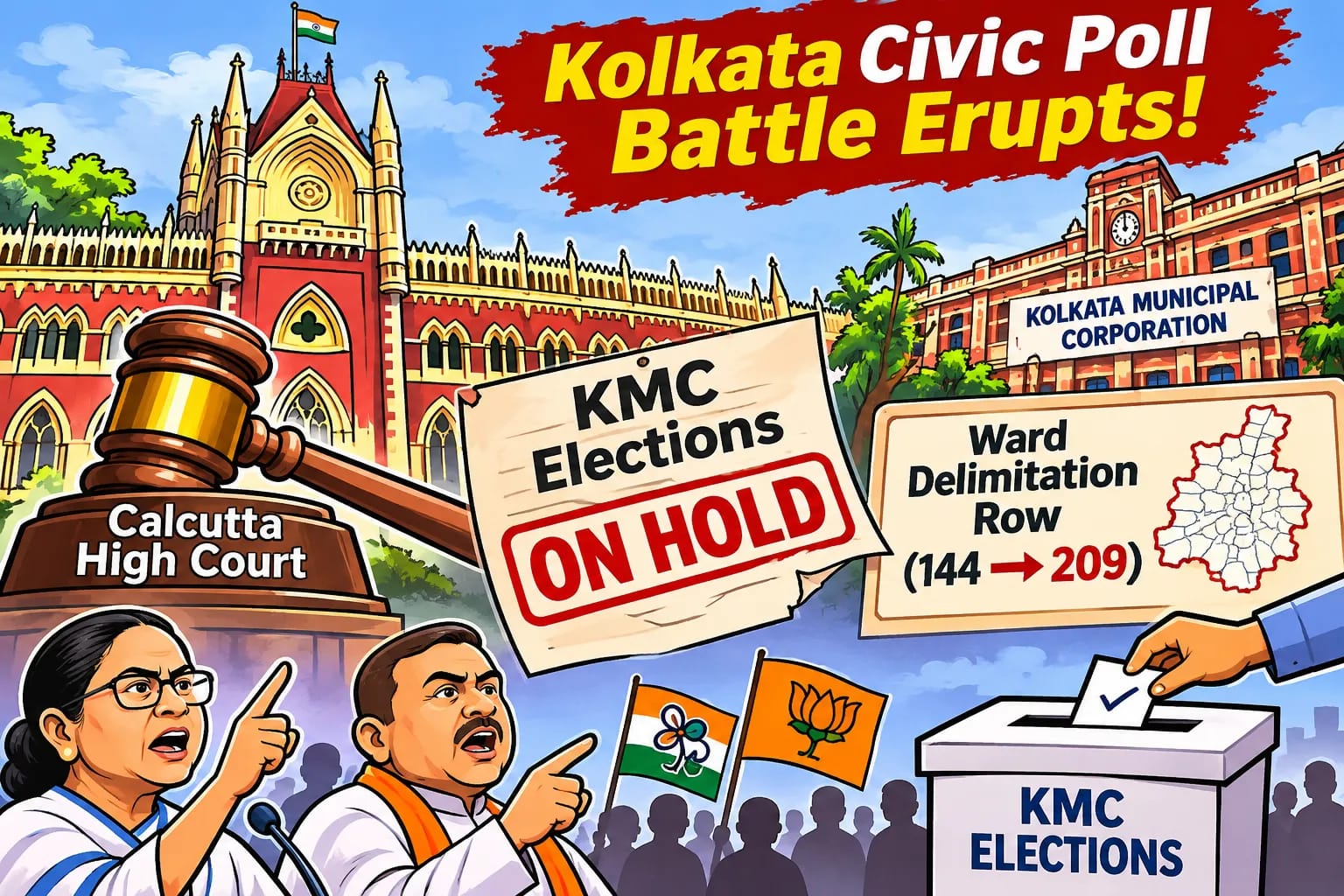
Kolkata's municipal politics has been thrown into fresh uncertainty after the Calcutta High Court intervened in the ongoing ward delimitation. In a significant development reported on November 7, 2026, a division bench restrained the West Bengal State Election Commission from announcing Kolkata Municipal Corporation (KMC) elections until a single-judge bench decides the petition challenging the ward delimitation exercise.
The dispute centres on the expansion of Kolkata's municipal wards from 144 to 209, a change that has become a major legal and political flashpoint.
The court's intervention has put the spotlight on an important democratic question: can municipal elections proceed when the legal validity of the electoral boundaries themselves remains under challenge?
Why Has the Ward Delimitation Become Controversial?
Ward delimitation determines the geographical boundaries and representation of municipal constituencies. It directly affects how local communities are represented in elected civic institutions.
A former Kolkata councillor, Dipu Das, challenged the delimitation process, alleging that the exercise could amount to political gerrymandering.
His petition raised concerns about:
Alleged political advantage through changes in ward boundaries.
Whether geographical continuity and administrative convenience were properly considered.
The use of electoral rolls instead of population data as a basis for the exercise.
The potential exclusion of sections of residents from the delimitation process.
High Court Questions the Process
The division bench comprising Justices Sabyasachi Bhattacharyya and Arjun Ray Mukherjee observed that the petition had a sufficiently strong prima facie case to warrant judicial consideration.
The judges also expressed concern about the sequence of events surrounding the dissolution of the municipal board and the subsequent appointment of an administrator.
The court reasoned that announcing election dates based on the disputed 209-ward structure could make the pending legal challenge ineffective.
State Government Signals Its Next Move
The West Bengal government indicated that it would challenge the High Court's order.
Chief Minister Suvendu Adhikari also announced that coordinators would be appointed across all 209 wards after November 30 to work with the Kolkata Municipal Corporation administration and maintain service delivery.
The government's position highlights the administrative challenge of keeping municipal services operational while the election-related legal dispute remains unresolved.
Why This Matters for West Bengal Politics
The controversy is more than a technical disagreement over municipal boundaries.
Kolkata is one of West Bengal's most politically significant urban centres. Control over its municipal administration carries importance for local political organisation, public services and party influence.
The developments could have several implications:
1. Municipal election uncertainty: The announcement of civic election dates now depends on the progress of the legal proceedings.
2. Political accountability: The dispute has brought questions about transparency and fairness in the delimitation process into public debate.
3. Opposition scrutiny: Opposition parties are likely to closely examine the legal and administrative decisions surrounding the ward restructuring.
4. Governance concerns: With an administrator-led arrangement in place, the question of elected municipal representation remains significant.
What Happens Next?
The immediate focus will be on the single-judge bench's decision on the delimitation challenge and the government's proposed response to the division bench's order.
Until the legal issue is resolved, the State Election Commission cannot announce the Kolkata Municipal Corporation elections under the disputed arrangement.
The eventual outcome could influence not only the timing of the civic polls but also the legal framework governing Kolkata's municipal representation.
Conclusion: A Civic Election, A Political Test
Kolkata's ward delimitation dispute has turned into a significant test of electoral transparency and democratic accountability in West Bengal.
The question is no longer simply how many wards Kolkata should have. It is whether the process used to determine those wards can withstand legal scrutiny.
For political parties, the uncertainty creates another challenge. For citizens, the larger concern remains clear: an elected municipal body should represent people through a process that is transparent, lawful and accountable.
Kolkata's civic election battle is now heading through the courtroom before reaching the ballot box.


Join the discussion
Comments (0)