Kangana Ranaut Targets Sonia Gandhi Over Gandhi Family Deaths: Farmers' Remarks, Airport Controversy and Questions Over Political Responsibility
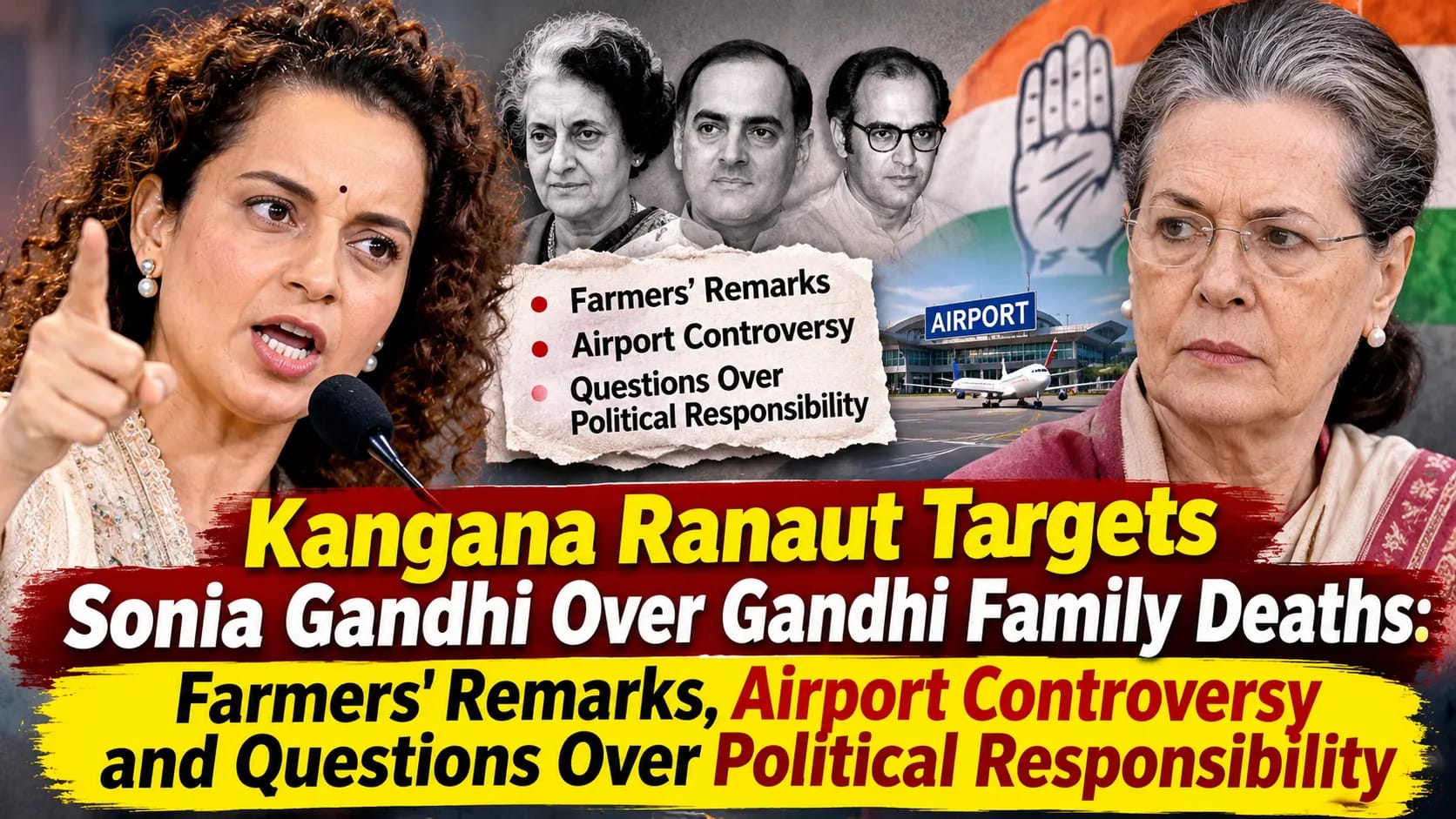
Kangana's Controversial Remarks on Sonia Gandhi
Kangana shared her views through Instagram Stories, questioning how Sonia Gandhi entered the Gandhi family and eventually became one of the most influential political figures in the Congress.
She referred to three major tragedies in the Gandhi family:
Sanjay Gandhi died in a plane crash in June 1980.
Indira Gandhi was assassinated by her bodyguards in October 1984.
Rajiv Gandhi was assassinated in a suicide bombing in Tamil Nadu in May 1991.
Kangana suggested that these events paved the way for Sonia Gandhi's political prominence and described the sequence as suspicious.
She also questioned the circumstances surrounding Maneka Gandhi's departure from the family home after Sanjay Gandhi's death.
These are serious insinuations. However, the deaths have documented historical circumstances, and no established evidence has demonstrated Sonia Gandhi's involvement in them.
Chandigarh Airport Incident: Public Anger Turns Into a Physical Attack
On June 6, 2024, Kangana was allegedly slapped by CISF constable Kulwinder Kaur at Chandigarh airport while travelling to Delhi.
Following the incident, a video circulated in which the constable referred to Kangana's earlier remarks about women participating in the farmers' agitation, including her own mother's participation.
The incident created a nationwide controversy.
Several people expressed sympathy with the farmers and criticised Kangana's earlier comments. Others strongly condemned the physical attack and supported her right to travel safely without being assaulted.
The CISF suspended the constable and initiated disciplinary proceedings.
It is important to separate the two issues: Kangana's remarks about farmers deserved public scrutiny, but physical violence against an elected representative cannot be justified as a form of protest.
Public Reaction: Is There One Standard for Political Leaders?
Kangana's latest remarks have generated another wave of discussion on social media.
The reactions broadly fall into different groups:
1. Criticism of Kangana's allegations
Many users have questioned why a sitting MP would make insinuations about the deaths of prominent political figures without presenting evidence.
They argue that political criticism should be based on documented facts rather than personal allegations.
2. Support for Sonia Gandhi
Some Congress supporters and social media users have highlighted Sonia Gandhi's personal losses, her decision to decline the Prime Minister's post in 2004 and her political contributions.
They argue that her foreign birth should not be repeatedly used to question her legitimacy in Indian public life.
3. Debate over the responsibility of elected representatives
Another important discussion concerns whether MPs should be more careful with their public statements.
Social media users have questioned whether personal accusations and unverified theories help public debate or distract from issues such as unemployment, inflation, farmers' problems and governance.
These reactions represent different online viewpoints, not a measured opinion of the entire public.
Is This the Standard of Public Debate Expected From an Educated Elected Representative?
A serious question emerges from this controversy: should the educational qualifications or political position of a public representative matter when evaluating the quality of their statements?
The issue is not about whether Kangana is educated or whether she has the right to criticise Sonia Gandhi.
She is entitled to question the Congress leadership, challenge political history and demand accountability.
But an elected MP also carries a responsibility to distinguish historical facts from personal assumptions.
When discussing the deaths of former Prime Ministers and other prominent public figures, evidence and historical records should take priority over insinuations.
Should a public representative make such serious allegations without documentary evidence? Should political criticism focus on governance, policies and accountability rather than repeatedly targeting personal identities and family tragedies?
These are questions worth asking of every political leader, regardless of party.
Conclusion
Kangana Ranaut's latest remarks against Sonia Gandhi have reopened an uncomfortable debate about political language, personal attacks and the responsibility of elected representatives.
Sonia Gandhi's political career can certainly be questioned, her decisions can be criticised and the Congress party's dynastic structure can be debated. But linking her to the deaths of family members without evidence crosses into unsupported allegations.
Similarly, Kangana's earlier comments about farmers deserve scrutiny, while the physical attack against her at Chandigarh airport must be condemned independently.
Indian democracy needs strong opposition, fearless questions and political accountability. But those principles should apply equally to everyone.
Join the discussion
Comments (0)