Assam's Electoral Battle Intensifies: Gaurav Gogoi Targets Centre Over SIR, Delimitation and EVMs – Is Election Administration Becoming a National Political Flashpoint?
Introduction: Electoral transparency becomes a political battleground
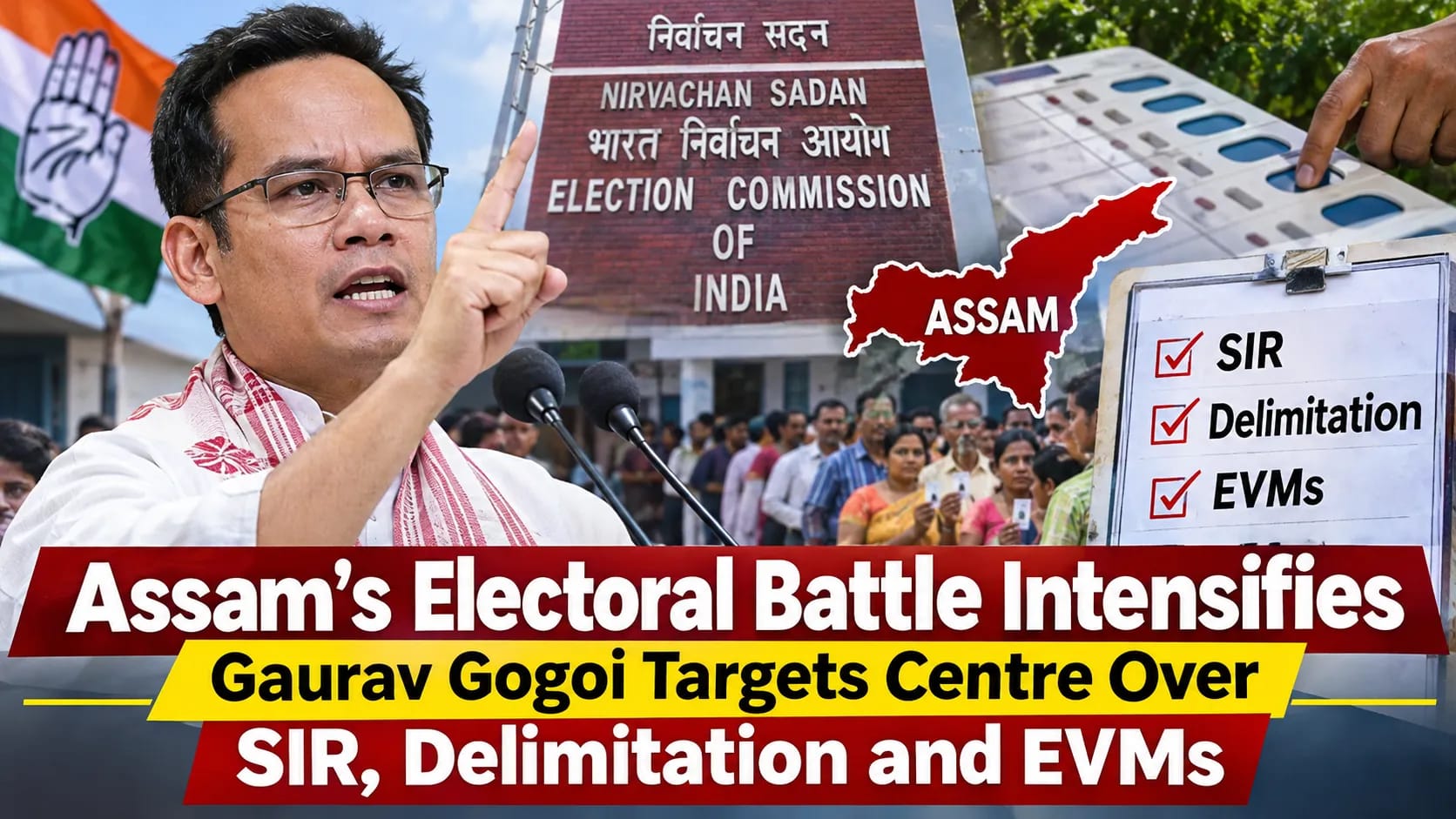
India's electoral administration has once again moved into the centre of political debate, with Congress MP Gaurav Gogoi raising a series of concerns over the Special Intensive Revision (SIR) of electoral rolls, delimitation, electronic voting machines (EVMs) and the functioning of election-related institutions.
In a political statement published on November 9, 2026, Gogoi accused the BJP-led Centre and the Election Commission of India (ECI) of creating an electoral environment that, according to him, raises questions about fairness and institutional independence.
The Congress leader presented a ten-point criticism covering several aspects of the electoral process, including voter-list revisions, constituency boundaries, political funding, transfers of government officials and the treatment of opposition parties.
Gaurav Gogoi's ten-point criticism puts the spotlight on the Centre
Gaurav Gogoi used a social media post to outline what he described as a series of concerns surrounding India's electoral system.
His criticism included:
Delimitation: Concerns about the redrawing of parliamentary constituencies.
SIR: Allegations concerning the inclusion of ineligible voters and deletion of genuine voters.
Electoral bonds: Questions about political funding and corporate donations.
Political defections: Allegations concerning the weakening and splitting of opposition parties.
Government transfers: Concerns about the relationship between administrative postings and political influence.
CEC protection: Questions about legal protections available to the Chief Election Commissioner.
Election scheduling: Concerns about the timing and management of election campaigns.
Model Code of Conduct: Allegations of inconsistent enforcement.
EVMs: Questions about electronic voting machine reliability.
Candidate scrutiny: Allegations of selective action against opposition candidates.
These points represent Gogoi's political allegations and should not be treated as independently established findings of electoral misconduct.
SIR controversy: Why voter-list revision remains sensitive
The Special Intensive Revision of electoral rolls has become a major point of disagreement between the Election Commission and several opposition parties.
The purpose of electoral-roll revision is to maintain accurate voter lists by identifying eligible voters, correcting errors and removing entries that do not meet legal requirements.
However, opposition parties have raised concerns about the possibility of genuine voters being excluded during the exercise.
An important Assam-specific distinction:
The latest electoral-roll exercise announced for Assam is a Special Summary Revision (SSR), not the same as the SIR exercise being discussed in Gogoi's wider political criticism. The distinction matters when reporting the issue: his remarks concern the national electoral debate and should not be presented as proof that Assam itself is undergoing an SIR exercise.
Why Assam is important in this debate
Assam occupies an important position in northeastern India's political landscape.
Electoral-roll accuracy, constituency representation and administrative neutrality are issues that can have significant implications for political participation in the state.
Gogoi's criticism also gives the Assam Congress an opportunity to connect state-level electoral concerns with the national discussion about democratic institutions.
Political implications: Opposition and Election Commission face questions
The Opposition is demanding greater transparency and accountability, while the Election Commission is responsible for implementing electoral procedures under the applicable constitutional and statutory framework.
The Centre and the BJP have also faced criticism from opposition parties over several election-related issues.
The wider controversy raises important questions:
Are electoral-roll revision procedures sufficiently transparent?
How can voters effectively challenge incorrect deletions?
What safeguards should govern delimitation?
How can confidence in EVMs and counting procedures be strengthened?
How should complaints against election administration be independently examined?
What happens next?
The coming months will be important for electoral preparations, voter registration and political discussions surrounding election administration.
Political parties are likely to continue raising questions about electoral transparency, while the Election Commission will remain responsible for implementing applicable procedures.
For Assam, attention should remain on the official electoral-roll revision schedule, opportunities for voter corrections and any formal decisions concerning constituency representation.
Conclusion
The debate is therefore not limited to one political party or one state. It concerns the transparency, accountability and credibility of the entire electoral process.
Join the discussion
Comments (0)