Regional Party Funding Under Spotlight! ADR 2026 Report Reveals BJD and JMM Donations, Corporate Contributions and Financial Gaps
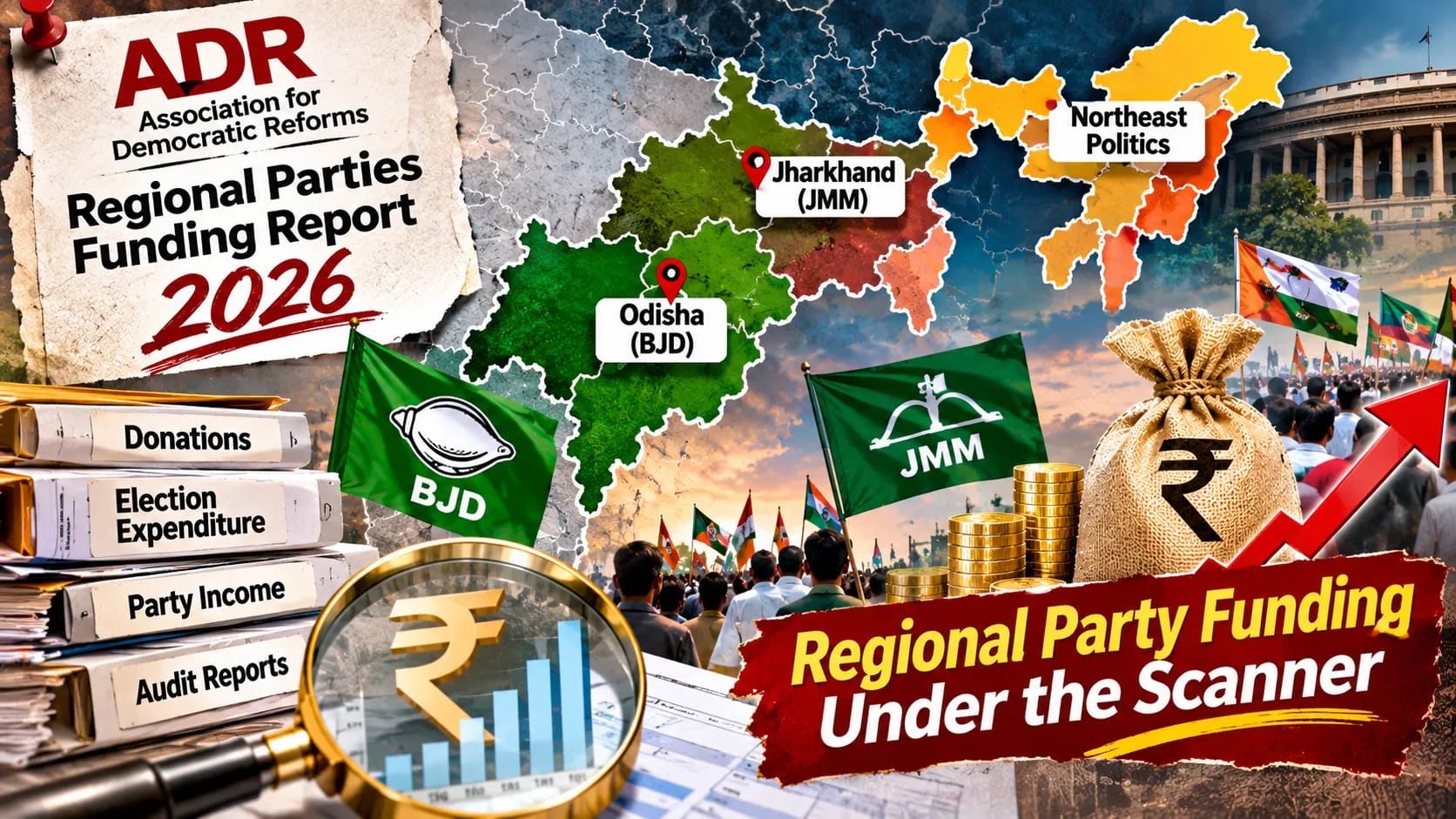
Regional political parties play an important role in India's democratic and federal structure. From Odisha and Jharkhand to the Northeast, these parties represent regional interests, participate in state governments and influence national political discussions.
How much money do regional parties receive? How much do they spend during elections? Who contributes to their political funds?
ADR report reveals ₹1,433 crore in expenditure
On May 27, 2026, ADR published its analysis of income and expenditure declared by regional political parties for the financial year 2024–25.
The report examined 36 of India's 67 regional political parties whose audited accounts were available for the analysis.
Its major findings included:
Total declared income: ₹1,192.944 crore.
Total declared expenditure: ₹1,433.068 crore.
Expenditure exceeded declared income by ₹240.124 crore.
Fifteen parties spent more than 55% of their total expenditure on election-related activities.
BJD election expenditure attracts attention in Odisha
Odisha's Biju Janata Dal (BJD) is among the regional parties included in the ADR analysis.
According to the report, BJD recorded total expenditure of ₹288.44 crore during FY 2024–25.
It was the second-highest expenditure among the 36 parties analysed.
The report further stated that BJD spent ₹270.663 crore under election expenditure.
JMM contributions and political funding in Jharkhand
Jharkhand Mukti Morcha (JMM) is another regional political organisation covered by ADR's financial analysis.
The August 6, 2026 report on regional party donations examined contributions above ₹20,000 declared for FY 2023–24 and FY 2024–25.
According to the findings, JMM received ₹33 crore in declared donations in FY 2024–25.
Corporate contributions dominate regional political funding
The report examined 8,158 donations above ₹20,000, amounting to ₹1,399.249 crore across the two financial years.
Corporate and business houses contributed ₹872.538 crore, accounting for 62.36% of the total declared donations.
Individual donors contributed ₹193.946 crore, representing 13.86% of the total value.
Financial transparency: What needs attention?
The ADR findings identify several areas that deserve closer public scrutiny:
1. Timely financial statements
Political parties should submit audited accounts and contribution reports within the prescribed deadlines.
2. Donor information
Accurate donor names, addresses and PAN details help citizens understand the sources of political funding.
3. Election expenditure
Election-related spending should be clearly distinguished from administrative and organisational expenses.
4. Corporate contributions
Corporate donations deserve transparent reporting so that citizens can examine the structure of political financing.
Conclusion
Ultimately, transparent political funding helps citizens better understand the financial structures behind India's regional democratic institutions.




Join the discussion
Comments (0)