
Sonia Gandhi Is Still Called Italian: Why Does BJP Question Her Identity While Demanding Respect for Its Own Families?
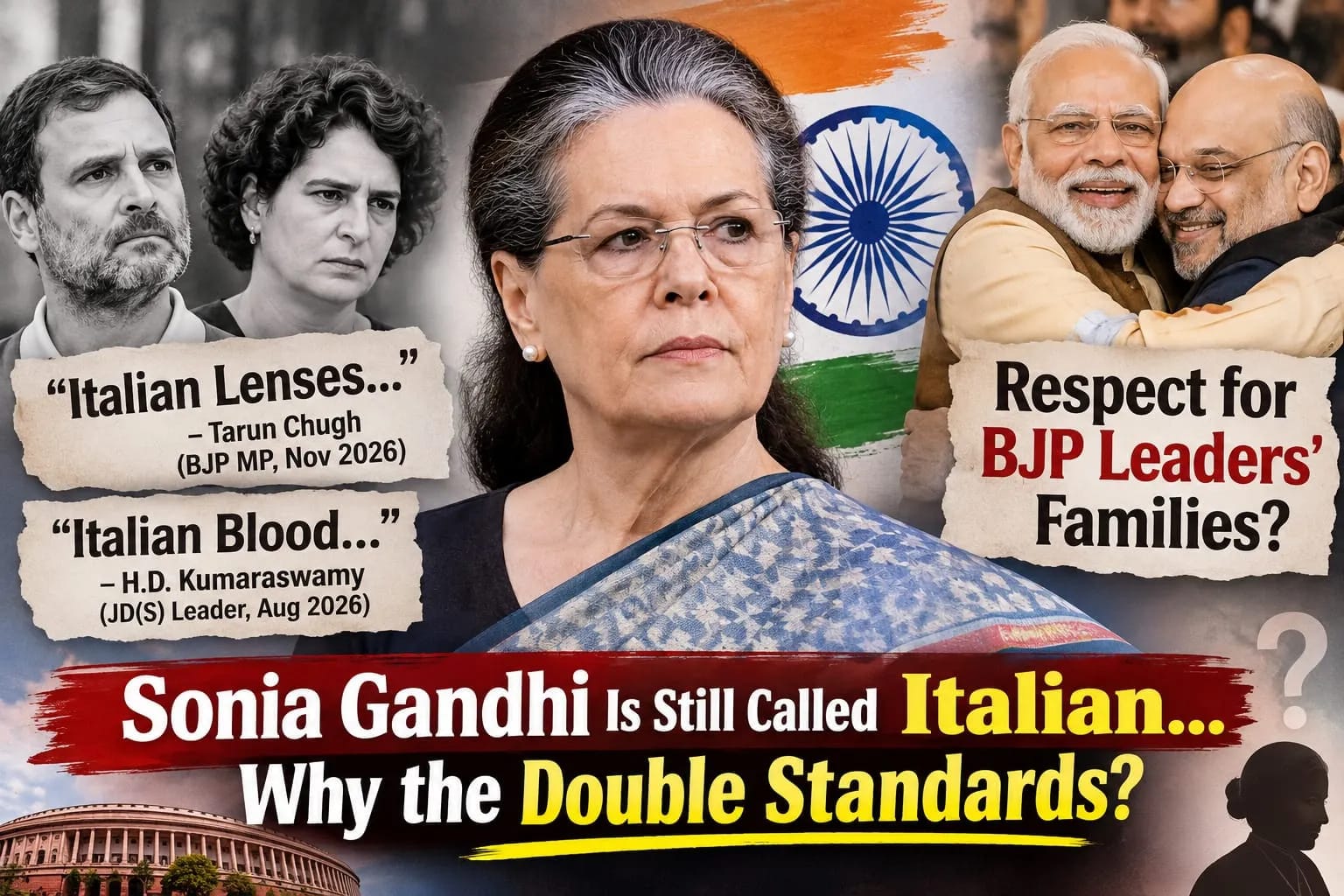
On November 7, 2026, BJP Rajya Sabha MP Tarun Chugh asked Sonia Gandhi to remove her "Italian lenses" while responding to her criticism of the Modi government. In August 2026, NDA ally and JD(S) leader H.D. Kumaraswamy also questioned her Indian identity, referring to her "Italian blood" during the Vande Mataram controversy.
These remarks raise a bigger question about political double standards, personal dignity and the meaning of being Indian.
1. Why Does Her Italian Origin Keep Returning?
Sonia Gandhi was born in Italy in 1946. She married Rajiv Gandhi in 1968 and became an Indian citizen on April 30, 1983.
Following Rajiv Gandhi's assassination in 1991, she continued living in India. She later entered politics and became Congress president in 1998.
Her Indian citizenship was also upheld by the Supreme Court in 2001.
Yet, decades later, her Italian birthplace continues to feature in political attacks. BJP leaders have repeatedly raised her foreign origin, including during political controversies involving Narendra Modi, Subramanian Swamy and, most recently, Tarun Chugh.
The question is simple: If her citizenship is legally recognised, why should her birthplace repeatedly become an argument against her patriotism?
2. BJP's Stand on Family Respect: Does the Same Rule Apply to Everyone?
BJP leaders and supporters frequently speak about protecting family dignity, respecting mothers and sisters, and defending women against personal attacks.
There is also a recurring argument in political debates that when ordinary people make personal remarks about BJP leaders' wives, mothers or daughters, the issue is presented as an attack on family honour and women's dignity, often generating emotional sympathy.
But shouldn't the same principle apply when the woman being targeted belongs to the opposition?
Why should Sonia Gandhi's foreign birthplace become a subject of repeated personal remarks?
If targeting a BJP leader's family is considered unacceptable, why should personal references to Sonia Gandhi's origins be treated differently?
Respect for women cannot depend on political affiliation. A woman's dignity should not change depending on whether she supports the ruling party or the opposition.
Sonia Gandhi can certainly be questioned about her political decisions, leadership and influence. But political disagreement should not become an excuse for repeatedly targeting her personal identity.
3. A Family That Experienced a National Tragedy
On May 21, 1991, Rajiv Gandhi was assassinated during an election campaign in Sriperumbudur, Tamil Nadu.
Sonia Gandhi lost her husband, and Rahul and Priyanka Gandhi lost their father.
It was a tragedy that shook the entire nation.
Sonia Gandhi subsequently continued her life in India and eventually entered politics. Her children also became part of India's democratic process.
People can disagree with the Gandhi family's political influence, but personal tragedy should be discussed with humanity.
She did not choose the circumstances in which her husband died. Her political decisions can be questioned, but her family's loss should not become another reason to question her belonging to India.
4. Why Is Indian Identity Judged Differently?
India celebrates people of Indian origin who live abroad and achieve success in business, technology, science and public life. Political leaders across parties have recognised the achievements of the Indian diaspora.
Then why does Sonia Gandhi's foreign birthplace remain such a persistent political issue?
The circumstances may be different, but the larger question is about consistency.
If people who settle abroad can maintain their connection with India, why should someone who came here after marriage, acquired Indian citizenship and built her life here be permanently defined by her birthplace?
India's citizenship laws recognise legally acquired citizenship. National identity should not become a political weapon.
Conclusion: Respect Should Not Depend on Political Affiliation
The BJP has every right to question Sonia Gandhi and the Congress party. Congress also has every right to question the BJP and its leaders.
But democracy requires consistency.
If the family members of BJP leaders deserve dignity, the same dignity should extend to Sonia Gandhi. If women deserve respect, that respect should not depend on their political party. And if Indian citizenship is recognised by law, birthplace should not repeatedly be used to question someone's belonging.
Sonia Gandhi was born in Italy, but she became an Indian citizen, built her family in India and spent decades in this country.
The question India should ask is this: If personal attacks on a BJP leader's family can become an issue of women's dignity and family honour, why should Sonia Gandhi be treated differently? Is respect for women a universal principle or does it change with political convenience?




Join the discussion
Comments (0)