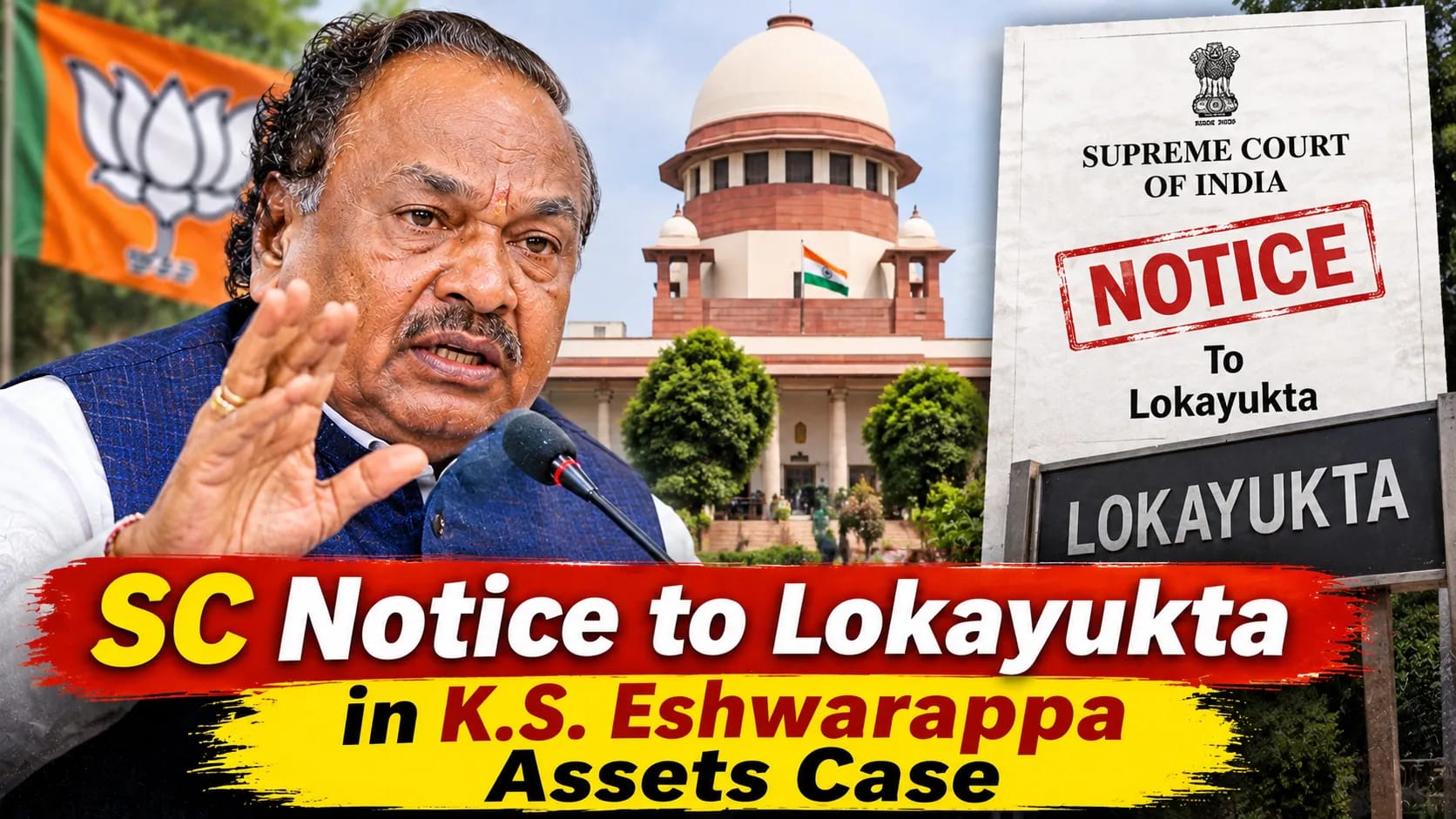
Supreme Court Issues Notice to Lokayukta in K.S. Eshwarappa Disproportionate Assets Case: Legal Battle Takes New Turn
What Are the Allegations Against Eshwarappa?
The case involves allegations that Eshwarappa, his son K.E. Kantesh and daughter-in-law Shalini accumulated assets beyond their known sources of income.
A complaint was filed by Shivamogga-based advocate B. Vinod, who alleged that the family acquired substantial movable and immovable properties and operated several business establishments.
The allegations include properties, educational institutions and other business investments. However, these claims remain subject to investigation and judicial examination.
How Did the Case Reach the Supreme Court?
The Lokayukta police had earlier submitted a closure report, commonly known as a B-report. However, the complainant challenged the report before the special court dealing with cases involving elected representatives.
The court subsequently directed a fresh investigation, following which the Lokayukta police registered a new FIR.
Eshwarappa and his family challenged the investigation before the Karnataka High Court. On July 3, 2026, the High Court rejected their petition, allowing the Lokayukta investigation to continue. The court also recorded the prosecution's assurance that no coercive action would be taken if the petitioners cooperated with the investigation.
Eshwarappa Moves Supreme Court
Unhappy with the High Court's decision, Eshwarappa approached the Supreme Court seeking relief against the ongoing proceedings.
The Supreme Court's latest notice to the Lokayukta marks another important stage in the legal battle. The investigating agency will now have to respond to the court's queries and provide relevant details.
Political Impact in Karnataka
The development is likely to attract political attention in Karnataka, particularly because Eshwarappa is a senior BJP leader and former Deputy Chief Minister.
The case could become a subject of discussion between political parties, with questions about accountability, transparency and the investigation of allegations against public representatives.
Conclusion
The Supreme Court's notice to the Lokayukta does not mean that Eshwarappa has been found guilty or that the case has been quashed. It is a step in the judicial process to examine his appeal and obtain the investigating agency's response.
The next developments will depend on the Lokayukta's explanation and the Supreme Court's subsequent proceedings. The central issue remains whether the allegations of disproportionate assets can be established through evidence.




Join the discussion
Comments (0)