
Tripura Civic Elections 2026: 21 Urban Local Bodies Head for November 27 Polls as BJP, Opposition Prepare for Crucial Contest
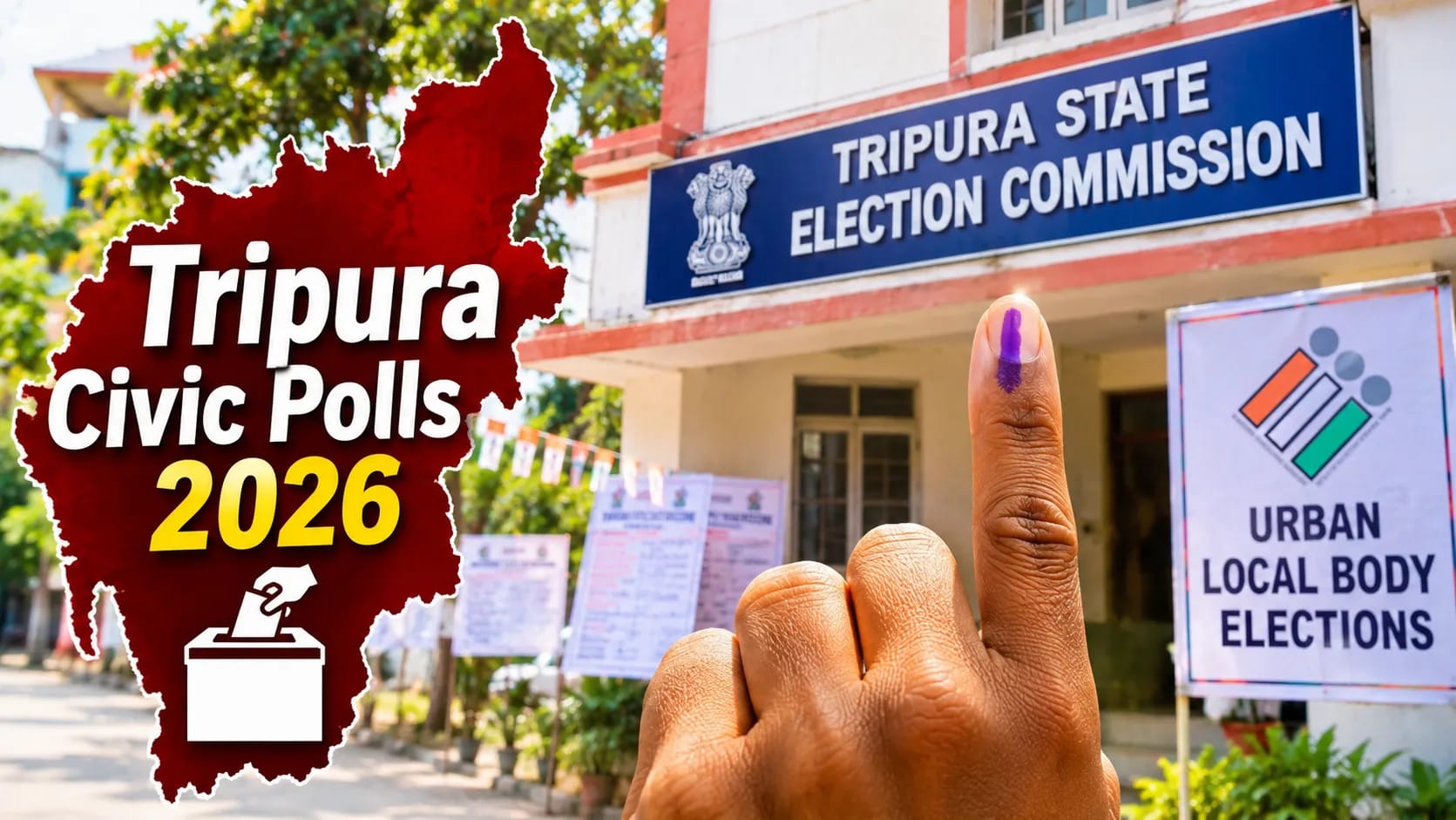
Tripura Enters Crucial Civic Election Phase
Tripura is heading towards an important electoral contest as the State Election Commission has announced November 27, 2026, as the polling date for elections to 21 urban local bodies.
The announcement has placed the state's political parties into election mode, with attention shifting towards candidate selection, local campaigning and preparations for the upcoming municipal contest.
The elections will cover 345 wards across 17 subdivisions in eight districts.
Among the most important electoral centres is the Agartala Municipal Corporation (AMC), which has 51 wards and remains a major urban political battleground.
State Election Commission Announces Poll Schedule
The Tripura State Election Commission announced the election schedule on October 30, 2026.
State Election Commissioner Pradip Kumar Chakravarty confirmed that voting would take place on November 27.
According to the announced schedule:
Election activity Date
Election announcement October 30
Nomination filing begins October 31
Last date for nominations November 6
Scrutiny of nominations November 7
Withdrawal deadline November 10
Polling November 27
Counting December 2
21 Urban Local Bodies and 345 Wards
The upcoming elections will cover 21 urban local bodies, making this a significant electoral exercise for Tripura.
The Agartala Municipal Corporation is among the most closely watched institutions because of its size and political importance.
The 345 wards provide political parties with opportunities to demonstrate their organisational strength across different urban centres.
The electoral exercise will also involve municipal councils and Nagar Panchayats.
According to the State Election Commission's announcement, approximately 6,29,903 voters are eligible to participate in the civic elections.
This includes 3,21,745 women and 3,08,115 men, according to the reported figures.
Why Are These Elections Politically Important?
Municipal elections are often viewed as local contests, but their political importance extends beyond urban administration.
For the ruling party, a strong performance can reinforce public confidence in its governance and organisational machinery.
For opposition parties, the elections offer an opportunity to challenge the ruling establishment and demonstrate their electoral relevance.
The results may also provide political parties with important insights into voter sentiment ahead of future state-level electoral contests.
BJP's Urban Political Position Under Attention
The BJP will be looking to maintain its political influence in the state's urban areas.
Municipal elections provide an opportunity for the party to highlight its development programmes, urban infrastructure initiatives and governance record.
However, the party will also face the challenge of managing local-level candidate expectations, ward-level dissatisfaction and competition within its organisational structure.
Urban voters often assess political parties on practical issues rather than only broader ideological positions.
Opposition Parties Face an Important Test
For opposition parties, the civic elections provide an opportunity to challenge the BJP's political influence.
The Left parties and Congress will need effective local campaigning, candidate selection and voter mobilisation to strengthen their position.
The extent of opposition coordination, where it occurs, may also influence the contest in selected urban areas.
Urban Governance at the Centre of the Contest
Beyond party competition, the elections will determine the leadership of institutions responsible for urban governance.
Municipal bodies play a direct role in managing civic facilities and implementing development initiatives.
Voters are therefore likely to assess candidates on their ability to improve local services.
Important issues could include:
Drinking water availability.
Road construction and maintenance.
Drainage and flood management.
Garbage collection and sanitation.
Street lighting.
Urban transport and traffic management.
Public spaces and municipal infrastructure.
December 2 Counting to Determine the Political Outcome
Counting of votes is scheduled for December 2, 2026.
The results will provide an important indication of political support across Tripura's urban local bodies.
A strong performance by the ruling party could strengthen its position, while opposition gains could signal changing voter preferences in selected urban centres.
However, municipal election results should not automatically be treated as a direct prediction of future Assembly election outcomes.
What Happens Next?
With the nomination process progressing, the immediate focus will be on candidate scrutiny, withdrawals and finalisation of contestants.
Political parties are expected to intensify their ward-level campaigns as polling day approaches.
The November 27 elections will test their ability to mobilise voters and address local governance concerns.


Join the discussion
Comments (0)