₹60,243 Crore Less in State Tax Transfers! Centre's Spending Figures Put Federal Funding and Budget Accountability Under Spotlight
Introduction
Government spending and the distribution of financial resources between the Centre and states have returned to the political spotlight following the publication of the Union government's monthly accounts up to August 2026.
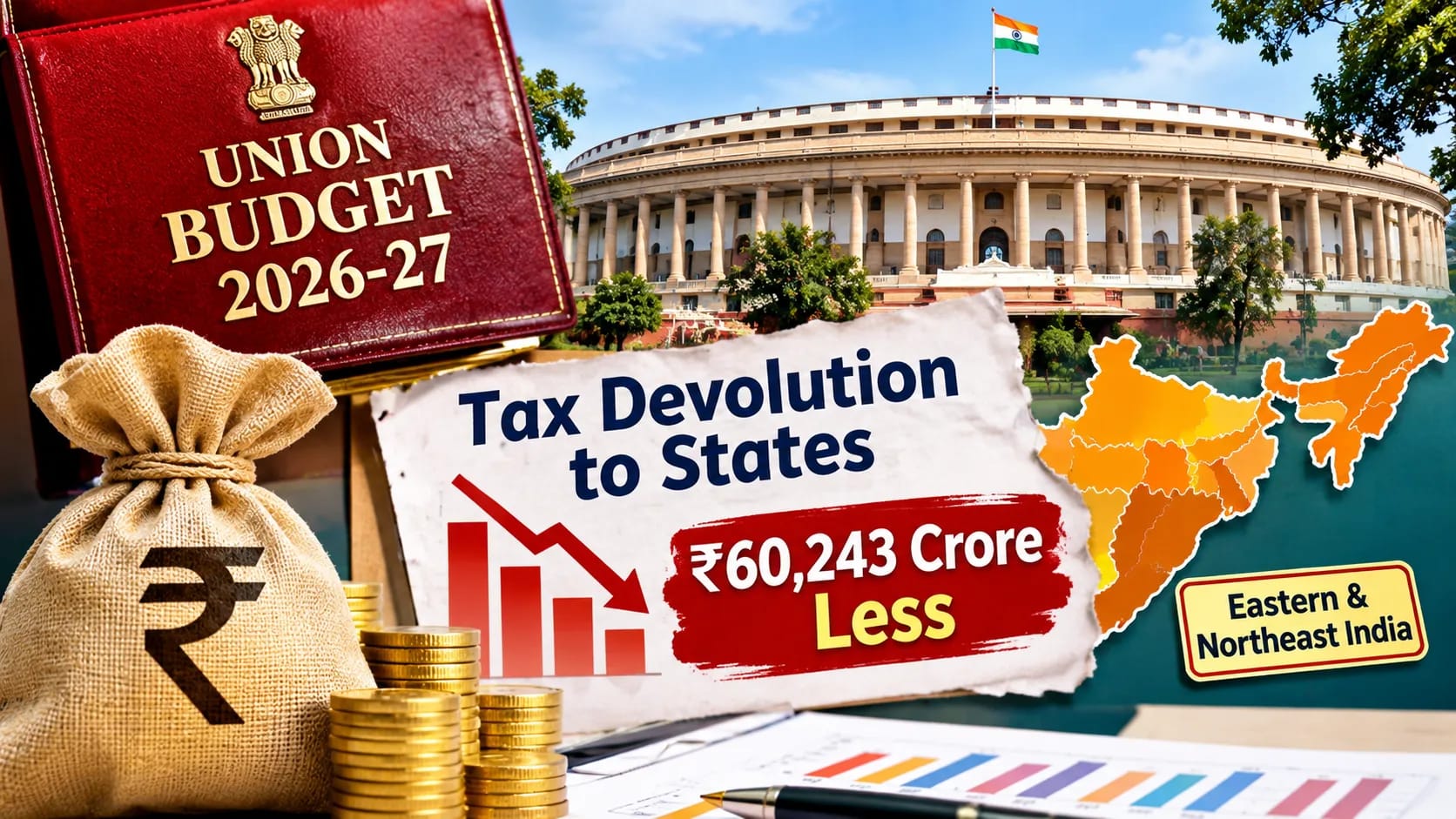
According to the Ministry of Finance's official review released on September 30, the Union government transferred ₹5,90,391 crore to state governments as their share of taxes up to August 2026.
The amount was ₹60,243 crore lower than the corresponding period in the previous financial year.
The figures have raised an important public-finance question: how should the Centre balance its expenditure priorities while ensuring that state governments receive the resources needed to implement development programmes?
What Do the Latest Government Figures Reveal?
The Ministry of Finance's monthly review of Union government accounts for April–August 2026 reported the following figures:
Total Union government receipts: ₹13,67,709 crore.
Tax revenue (net to Centre): ₹8,37,921 crore.
Non-tax revenue: ₹4,54,549 crore.
Non-debt capital receipts: ₹75,239 crore.
Tax devolution transferred to states: ₹5,90,391 crore.
Total government expenditure: ₹20,77,958 crore.
The tax devolution figure was ₹60,243 crore below the corresponding previous-year amount.
This is a year-on-year comparison of the amount transferred during the period. It does not, by itself, establish that any particular state suffered a reduction in its allocation or that the Centre failed to meet its budget commitments.
Eastern and Northeastern States: Why Does Tax Devolution Matter?
State governments depend on their share of central taxes alongside their own tax and non-tax revenues, grants and other sources of funding.
The August 2026 additional tax-devolution instalment provides an illustration of the distribution across the region.
According to the Ministry of Finance, the additional instalment of ₹1,09,019 crore released on August 1 included:
State Amount (₹ crore)
West Bengal 7,866
Odisha 4,819
Bihar 10,845
Jharkhand 3,660
Chhattisgarh 3,602
Assam 3,552
Arunachal Pradesh 1,476
Manipur 682
Meghalaya 688
Mizoram 615
Nagaland 524
Sikkim 365
Tripura 699
These figures represent the additional August instalment, not the total tax devolution received by each state during the financial year.
The Budget Accountability Question
The Union Budget 2026–27 estimated total government expenditure at approximately ₹53.47 lakh crore.
According to the analysis published by PRS Legislative Research, this represents an increase of 7.7% over the revised estimate for 2025–26.
The Budget also projected public capital expenditure of ₹12.2 lakh crore.
First: Government spending priorities.
The Centre has committed substantial resources to infrastructure, manufacturing, strategic sectors and other development programmes. The key accountability question is how effectively these allocations translate into completed projects and public benefits.
Second: Financial resources available to states.
States need predictable financial transfers to plan and implement their own development priorities. Tax devolution therefore remains an important part of Centre-State fiscal relations.
The difference between the budgeted figures and actual transfers must be assessed through official accounts over the full financial year rather than drawing conclusions from a single five-month period.
Political Implications for Eastern India
For Odisha, Bihar, Jharkhand, West Bengal and the Northeastern states, the distribution and timing of central financial resources are important governance issues.
State governments must balance expenditure on infrastructure, public services, rural development and welfare programmes.
The latest figures provide a basis for further scrutiny of:
Whether budgeted transfers are being released according to the planned schedule.
How effectively states are using available funds.
Whether capital expenditure is translating into completed development projects.
How Centre-State financial coordination affects regional development.
However, the published national figures do not establish that any specific Eastern or Northeastern state has experienced a funding crisis.
A state-wise comparison of actual receipts, budget estimates and revised estimates would be necessary before drawing that conclusion.
What Happens Next?
The coming monthly government accounts will provide further information about revenue collection, expenditure and tax devolution during the remaining months of FY 2026–27.
Parliamentary scrutiny, official budget documents and state-level financial reports will be important for evaluating whether the government's spending plans are being implemented as announced.
Conclusion
Ultimately, budget accountability is not just about how much the government announces or spends. It is also about transparency, timely transfers and measurable public benefits.


Join the discussion
Comments (0)