
Asaduddin Owaisi Opposes Maharashtra's UCC Move, Calls It a 'Hindu Civil Code' Targeting Non-Hindus
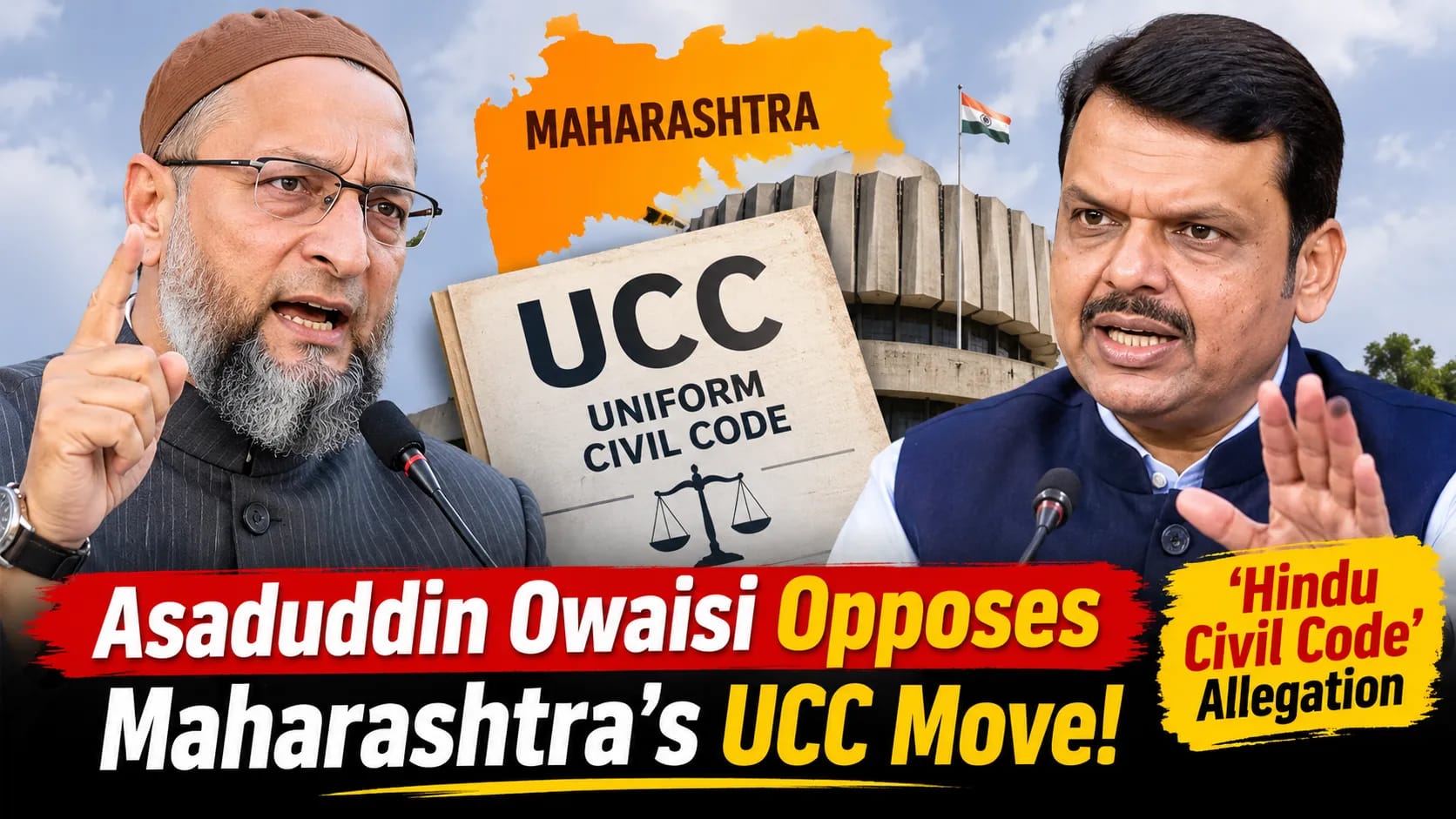
Owaisi Questions Maharashtra Government's UCC Proposal
Addressing a press conference, Asaduddin Owaisi described the proposed UCC as a 'Hindu Civil Code' rather than a genuinely uniform law.
He argued that the government's questionnaire, circulated as part of the public consultation process, appeared to focus heavily on practices such as polygamy and extra-judicial divorce while allegedly avoiding questions about the Hindu Undivided Family (HUF).
Owaisi also questioned why certain tribal customs were being considered while Muslim personal practices were allegedly not receiving similar consideration.
He maintained that different religious communities have their own marriage, divorce and inheritance practices, and expressed concern that the proposed legislation could affect constitutionally protected religious freedoms.
Marriage and Divorce Become Major Points of Controversy
One of Owaisi's major objections concerns the treatment of marriage and divorce under the proposed law.
He argued that Islamic marriage, known as Nikah, is a contractual relationship and questioned the possibility of applying provisions associated with the Hindu Marriage Act to Muslim marriages.
He also raised concerns about the treatment of Khula, through which Muslim women can seek divorce, and argued that a common legal framework should not ignore differences in religious practices.
Owaisi announced that AIMIM would oppose the proposed UCC when it comes before the Maharashtra legislature.
Devendra Fadnavis Defends UCC, Hits Back at Owaisi
Maharashtra Chief Minister Devendra Fadnavis has defended the government's decision, arguing that the Uniform Civil Code has constitutional backing.
Referring to Article 44 of the Indian Constitution, which directs the state to endeavour to secure a Uniform Civil Code for citizens, Fadnavis described its introduction as a constitutional responsibility.
He also criticised Owaisi's objections, arguing that the Constitution itself provides the foundation for states to work towards implementing a common civil code.
However, Fadnavis acknowledged that Directive Principles of State Policy are not enforceable in the same manner as Fundamental Rights and that implementation requires time and public consensus.
A Bigger Debate Over Religious Freedom and Equal Laws
The controversy has once again brought two important constitutional questions into the political discussion: whether India should have common civil laws for all citizens and how such laws should protect religious freedom and community-specific practices.
Supporters of UCC argue that common civil laws could promote equal treatment in matters such as marriage, divorce, adoption and inheritance.
Opponents, including Owaisi, question whether the proposed framework would genuinely treat all communities equally or disproportionately affect minority personal laws.
The debate is therefore not limited to political parties. It also concerns constitutional rights, gender equality, religious freedom and the future of personal laws in India.
Conclusion
The confrontation between Asaduddin Owaisi and Devendra Fadnavis has added another political dimension to Maharashtra's proposed Uniform Civil Code.
While the state government maintains that UCC is supported by constitutional principles, Owaisi argues that the proposed framework risks affecting the religious identity and personal laws of non-Hindu communities.
The crucial question now is whether Maharashtra's final UCC proposal can address concerns about equality, religious freedom and the rights of different communities while moving towards a common civil legal framework.


Join the discussion
Comments (0)