
Bastar Security Review Row: Protection Reduced for 116 Leaders in Chhattisgarh
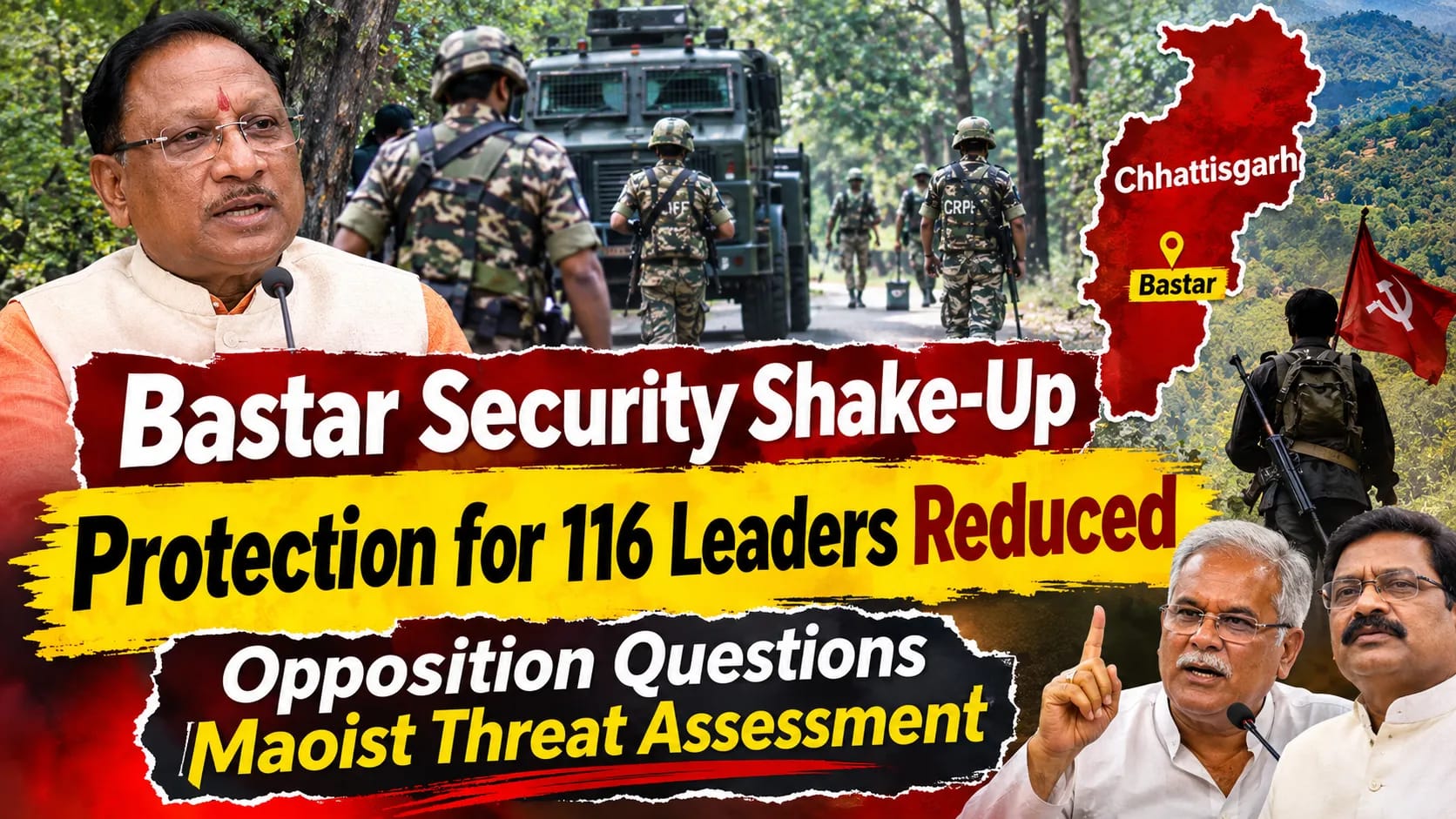
Bastar security review triggers a fresh political confrontation
A security-related decision in Chhattisgarh's Bastar region has sparked a fresh political debate after protection arrangements for 116 leaders were reportedly reduced following a government review.
The move has drawn attention to the difficult balance between security requirements, government assessments and the protection of political representatives in a region that has long faced Maoist-related violence.
The security review has now become a political issue, with concerns being raised about whether the threat level in Bastar has declined sufficiently to justify changes in protective arrangements.
The controversy is likely to bring the government's security assessment process under scrutiny, particularly as political leaders and opposition representatives debate whether the decision is appropriate given the region's security history.
Protection for 116 leaders reportedly reduced
The reported reduction in security protection for 116 leaders has become the central point of the controversy.
Security arrangements for political leaders are generally determined through threat assessments, intelligence inputs and reviews by relevant authorities. Such assessments may consider the nature of threats, the location of political activities, past incidents and changing security conditions.
The latest reported decision in Bastar has raised questions about how the review was conducted and what factors influenced the reduction in protection.
The political debate is likely to focus on whether the decision reflects an improved security situation or whether concerns remain about the potential risks facing political figures in the region.
Maoist threat assessment becomes the political flashpoint
Bastar has remained one of the most politically and security-sensitive regions of Chhattisgarh.
The Maoist issue has influenced government policy, security deployment, political activity and public debate for years. Any major change in security arrangements therefore attracts considerable attention.
The latest review has reopened the debate over how authorities measure the decline or persistence of Maoist-related threats.
Opposition concerns could intensify
The security review has the potential to become a broader political confrontation if opposition leaders question the decision or demand additional clarification.
Opposition criticism may centre on whether the government has adequately evaluated the risks before changing protection arrangements.
Questions could also emerge regarding the criteria used for the review, the officials involved in the assessment and whether the affected leaders were informed of the decision through appropriate procedures.
Government's security policy under scrutiny
For the government, the reported reduction in protection may be part of a broader review of security resources and deployment.
Authorities periodically assess protective arrangements to ensure that security resources are assigned according to current requirements rather than automatically maintained without review.
Bastar's security situation remains central to the debate
The political controversy cannot be separated from the wider security situation in Bastar.
The region has experienced prolonged Maoist insurgency-related challenges, and security developments have remained a major issue in state politics.
Government claims regarding improved security conditions, operations against insurgent networks, development initiatives and the expansion of administration into affected areas are often central to political messaging.
Security decision or political controversy?
The central question emerging from the controversy is whether the reduction in protection is primarily an administrative security decision or whether it will become a major political issue.
Security reviews are ordinarily based on risk assessments. However, when a large number of political leaders are affected at once, parties may seek further information and public clarification.
What happens next?
Several developments will determine how this controversy unfolds:
Whether the government releases an official explanation for the security review.
Whether opposition parties formally challenge the reduction in protection.
Whether affected leaders raise concerns with security authorities.
Whether the administration provides additional clarification about threat assessment criteria.
Whether the issue expands into a larger debate over Bastar's security situation.
Conclusion
The reported reduction in security protection for 116 leaders in Bastar has opened a new political debate in Chhattisgarh.
The controversy brings security assessments, the Maoist threat and government decision-making into focus. While authorities may review protection arrangements based on changing conditions, political concerns are likely to remain until the reasoning behind the decision is clearly explained.







Join the discussion
Comments (0)