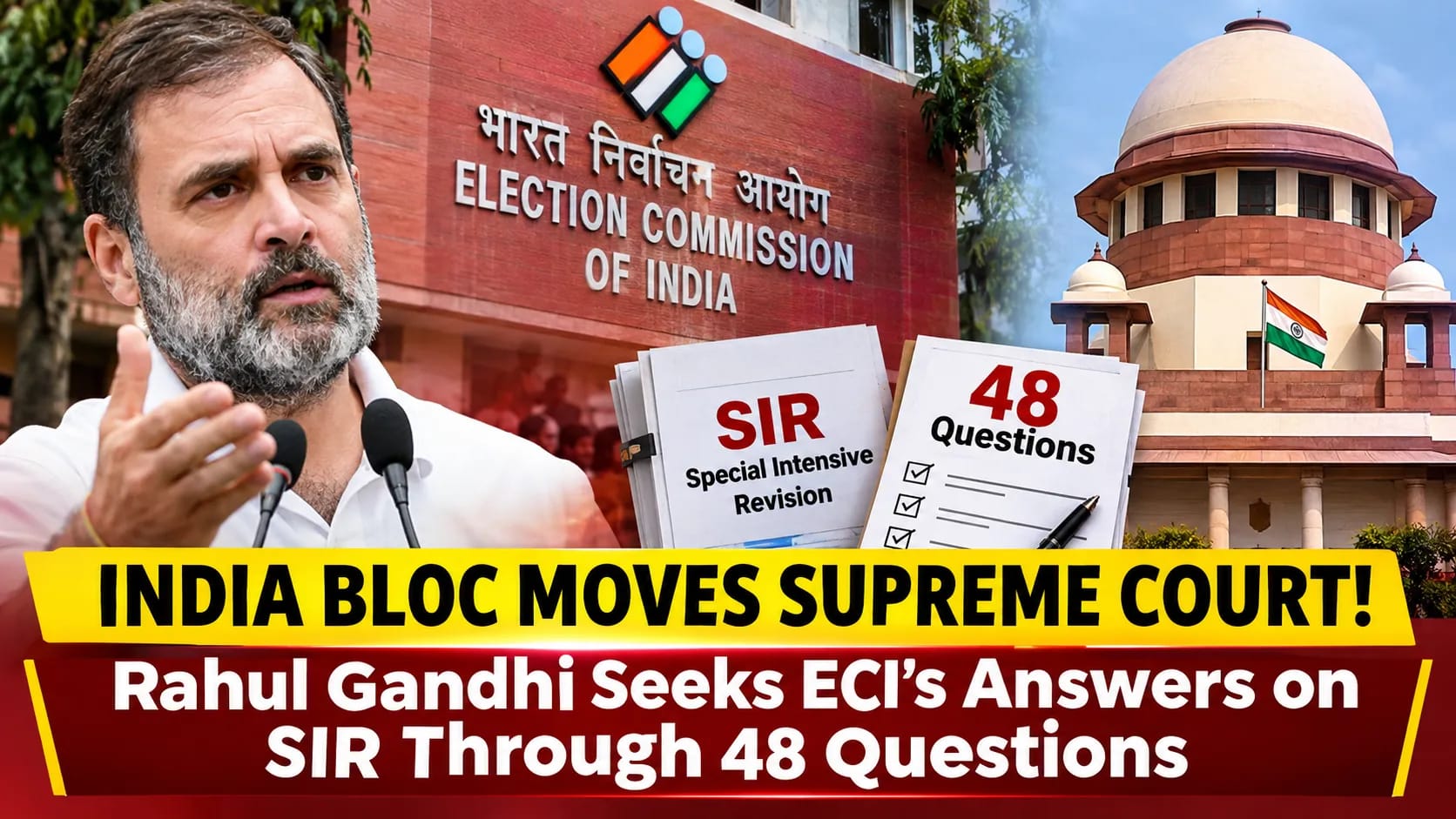
INDIA Bloc Takes Election Commission to Supreme Court! Rahul Gandhi Seeks Answers Through 48 Questions on SIR Controversy
Introduction: A New Legal Challenge Puts the Election Commission Under Scrutiny
A fresh political and legal confrontation has emerged over India's electoral process, with Congress leader Rahul Gandhi and other INDIA bloc leaders approaching the Supreme Court on November 16, 2026, seeking answers from the Election Commission of India (ECI) regarding the nationwide Special Intensive Revision (SIR) of electoral rolls.
The Opposition leaders have submitted an application seeking the court's permission to serve 48 written questions, formally known as interrogatories, on the Election Commission and relevant senior officials.
The application seeks detailed explanations about how major decisions concerning the electoral roll revision were taken, whether the Election Commission acted collectively, and what procedures were followed while implementing changes to voter registration systems.
The questions also address alleged voter exclusions, modifications to the online Form 6 application process and the functioning of digital platforms used for maintaining electoral records.
Why Has the INDIA Bloc Approached the Supreme Court?
The application comes amid an ongoing legal challenge concerning the Election Commission's decision-making process and the implementation of the Special Intensive Revision.
Rahul Gandhi and the other petitioners have argued that the Election Commission's earlier submissions before the Supreme Court did not provide sufficient supporting information about the decision-making process.
According to the application, the poll panel referred to unanimous decisions concerning the SIR exercise but did not disclose all the relevant dates, file numbers, records and details of approvals.
The Opposition now wants these matters clarified through formal written responses supported by affidavits.
The 48 Questions: What Does the Opposition Want to Know?
The 48 proposed interrogatories cover several important areas of the Election Commission's functioning.
1. Decision-making behind the nationwide SIR
One of the central concerns involves the authorisation of the Special Intensive Revision.
The petitioners want details about when the Election Commission decided to undertake the nationwide exercise and how that decision was formally approved.
They have sought information about:
Dates of important Commission decisions.
Relevant official files and records.
Whether decisions were taken during meetings or through circulation of files.
Whether approvals were communicated electronically.
Whether any Election Commissioner recorded objections or disagreements.
2. Questions concerning the Election Commissioners
Another important part of the application concerns the role of Chief Election Commissioner Gyanesh Kumar and the other two Election Commissioners, Sukhbir Singh Sandhu and Vivek Joshi.
The petitioners have sought information about whether any objections, disagreements or reservations were recorded concerning SIR decisions, ECINET, Form 6 and related legal proceedings.
3. Form 6 changes and voter registration
The proposed interrogatories also raise questions about changes introduced to the online Form 6 application process.
Form 6 is used by eligible individuals to apply for inclusion of their names in electoral rolls.
The Opposition wants to know:
Who authorised the additional declaration introduced in the online application process?
When was the declaration introduced?
Was the change formally approved by the Election Commission?
How many applications were rejected, kept pending or left unprocessed because of the additional declaration or mapping-related requirements?
4. Alleged voter exclusions and electoral roll transparency
Voter inclusion and exclusion form another major part of the legal challenge.
The petitioners want details about the reasons recorded for such exclusions, including:
Death of registered electors.
Permanent or temporary shifting.
Absence during verification.
Duplicate entries.
Ineligibility under applicable electoral rules.
The questions also concern objections submitted through Form 7 and the action taken against allegedly false objections.
5. ECINET and digital electoral platforms
The petitioners have sought information about ECINET and the management of electoral roll databases.
Among the issues raised are whether Electoral Registration Officers had the facility to restore an electoral roll entry after it had been omitted or deleted.
The application also seeks clarification about whether electoral entries could be added, deleted or modified through bulk operations, system-level changes, de-duplication or data migration without individual orders from the appropriate Electoral Registration Officer.
Conclusion
Ultimately, the Supreme Court's consideration of the application will be an important development in determining how these questions are examined.
India's electoral democracy depends not only on conducting elections but also on maintaining public confidence in the accuracy, fairness and transparency of the electoral process.


Join the discussion
Comments (0)