
Odisha Voter List Controversy! BJD Questions SIR After Dual Voter ID Allegations Emerge in Kotia and Malkangiri
Introduction: Odisha's Electoral Revision Faces Fresh Political Questions
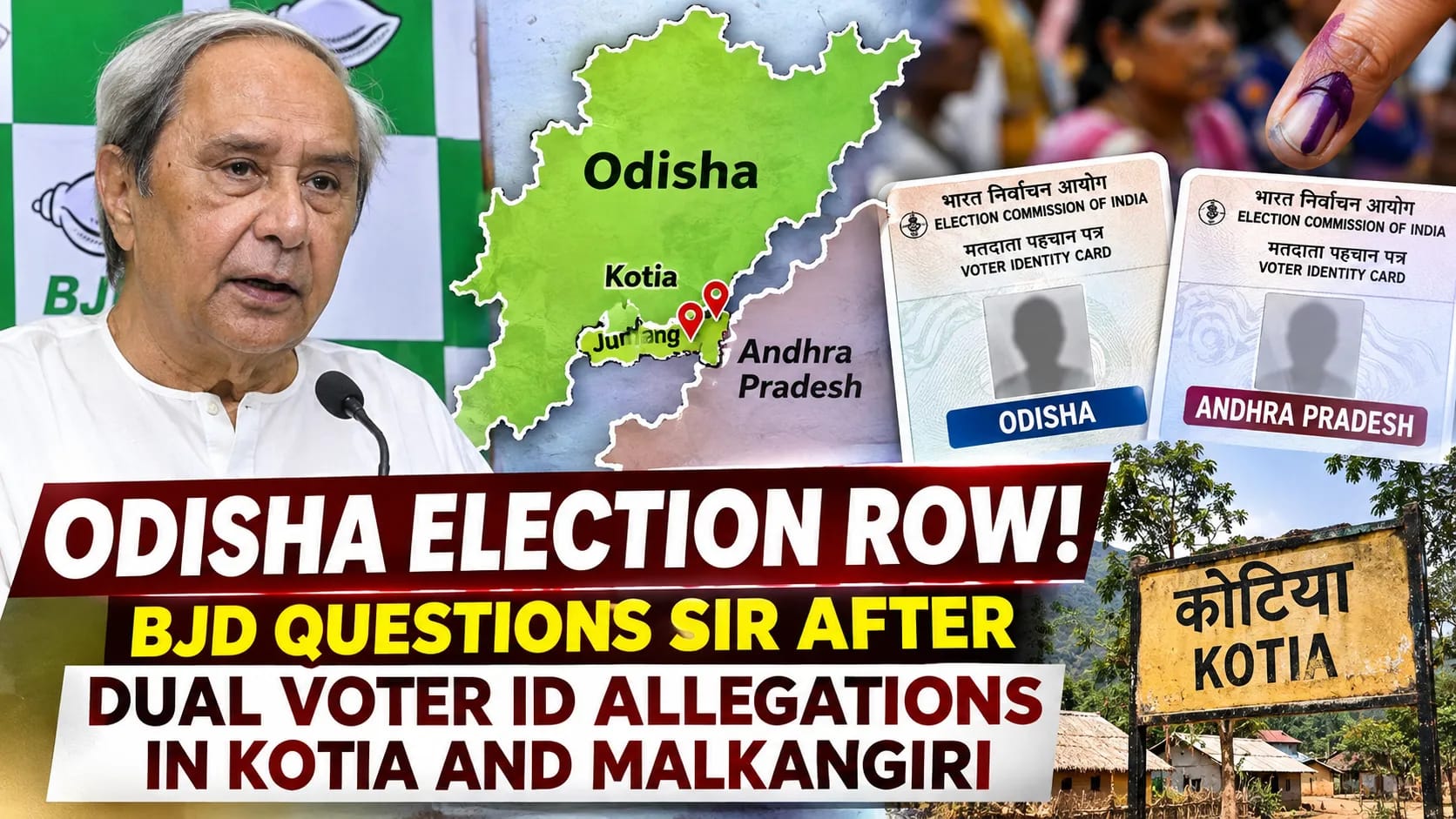
A new political controversy has emerged in Odisha after the Opposition Biju Janata Dal (BJD) questioned the effectiveness of the Special Intensive Revision (SIR) of electoral rolls, alleging that residents of certain Odisha-Andhra Pradesh border villages continue to possess voter identification cards issued by both states.
On November 11, 2026, senior BJD leaders Devi Prasad Mishra and Bijay Nayak raised the issue at a press conference in Bhubaneswar.
They questioned how residents of Kotia in Koraput district and Jumdang village in Malkangiri district could allegedly remain registered in electoral records associated with both Odisha and Andhra Pradesh after the SIR exercise.
The party demanded clarification from Odisha's Chief Electoral Officer and sought information about Odisha residents who participated in Andhra Pradesh's November 5 rural local body elections.
The controversy has placed electoral roll accuracy, voter registration procedures and the long-standing territorial dispute between the two neighbouring states under renewed political scrutiny.
What Triggered the Controversy?
The immediate trigger was the participation of some Kotia residents in Andhra Pradesh's rural local body elections on November 5.
According to BJD leaders, certain residents of border villages possessed voter identification cards issued by both states.
Former minister Devi Prasad Mishra questioned how such registrations could continue despite the completion of the electoral revision exercise.
He demanded that Odisha's Chief Electoral Officer obtain information from Andhra Pradesh regarding the number of Odisha residents who participated in its elections.
Why Kotia Is at the Centre of the Political Dispute
Kotia, located in Koraput district, has remained at the centre of a longstanding territorial disagreement between Odisha and Andhra Pradesh.
The region consists of several villages where competing administrative claims have created recurring disputes.
The issue extends beyond political boundaries. It involves local administration, public services, welfare schemes and the identity of residents.
During Andhra Pradesh's November 5 rural elections, some residents of the Kotia region reportedly crossed into the neighbouring state to vote.
Malkangiri's Jumdang Village Also Mentioned
The BJD's allegations also concern Jumdang village in Malkangiri district.
Party leaders claimed that some residents possessed voter identification cards issued by both Odisha and Andhra Pradesh.
They questioned whether the electoral revision process had adequately identified these cases.
What Did the Odisha Government Say?
Odisha Law Minister Prithiviraj Harichandan said the state government would examine the matter.
He indicated that the Revenue Department should identify individuals involved in dual voter identification cases and initiate legal action wherever violations are established.
The minister also stated that the Odisha administration had prevented Andhra Pradesh from establishing polling booths inside Kotia during its rural elections.
Meanwhile, Koraput Collector Manoj Satyawan Mahajan acknowledged that some residents of Kotia had crossed into Andhra Pradesh to participate in the elections.
He estimated that around 10% of Kotia voters had exercised their franchise in the neighbouring state's elections.
Why the Issue Matters for Odisha Politics
The controversy has wider implications for electoral administration in Odisha.
For the BJD, the issue raises questions about the effectiveness and transparency of the SIR exercise.
For the BJP-led state government, it creates an administrative challenge concerning voter registration and the management of disputed border areas.
For the Election Commission, the matter highlights the importance of accurate electoral databases and coordination between neighbouring states.
What Happens Next?
The next important development will be the response from Odisha's Chief Electoral Officer and the relevant authorities in Andhra Pradesh.
The key questions requiring clarification include:
How many residents are actually registered in electoral rolls of both states?
Were duplicate registrations formally identified?
What action has been taken against confirmed violations?
How many Odisha residents participated in Andhra Pradesh's rural elections?
Were eligible voters incorrectly excluded during the SIR exercise?
Conclusion
The BJD's latest allegations have brought the Special Intensive Revision of electoral rolls back into Odisha's political debate.
The reported presence of dual voter identification cards in Kotia and Jumdang has raised questions about registration procedures, inter-state coordination and the administration of disputed border areas.
The fundamental issue is clear: every eligible citizen must have the opportunity to vote, while electoral records must remain accurate, transparent and legally compliant.


Join the discussion
Comments (0)