Dravida Munnetra Kazhagam
Dravida Munnetra Kazhagam (DMK), founded in 1949, is a major political party in India. Explore its latest activities, statements, and role in the current political landscape.
Current vs. Opposition
Bharatiya Janata Party (BJP)
Ruling Party (National)
View profile Opposition
Dravida Munnetra Kazhagam (DMK)
Opposition Party
View profileHistory & Achievements
The Dravida Munnetra Kazhagam is a Dravidian political party whose ideology is associated with social justice, equality, secularism, rationalism, anti-caste politics, Tamil linguistic and cultural identity, federalism and state
1967–1969 | 1969–1976 | 1989–1991 | 1996–2001 | 2006–2011 | 2021–2026
History
The Dravida Munnetra Kazhagam was founded on 17 September 1949 by C. N. Annadurai after a split from the Dravidar Kazhagam led by Periyar E. V. Ramasamy. The DMK emerged as a political organisation seeking to take the principles of the Dravidian movement into electoral politics.
The party initially focused on social justice, anti-caste politics, Tamil identity, linguistic rights and greater state autonomy. Through political campaigns, public meetings, newspapers, theatre and cinema, the DMK developed a strong mass following in Tamil Nadu.
The party contested elections and expanded its presence during the 1950s and 1960s. In the 1962 Tamil Nadu Assembly election, the DMK became the principal opposition party.
A major turning point came in the 1967 Assembly election, when the DMK defeated the Congress and formed the government in Tamil Nadu. C. N. Annadurai became Chief Minister and became the first non-Congress Chief Minister of the state.
During the Annadurai government, the state was officially renamed Tamil Nadu, legal recognition was given to self-respect marriages, and the two-language policy was strengthened. These became important elements of the party's political legacy.
After Annadurai's death in 1969, M. Karunanidhi became Chief Minister and subsequently became the central leader of the DMK. Under Karunanidhi, the party won several Assembly elections and remained a major force in Tamil Nadu politics.
The DMK won the Tamil Nadu Assembly elections in 1971, 1989, 1996 and 2006 under Karunanidhi's leadership.
The party also became an important participant in national coalition politics. Under Karunanidhi, the DMK participated in several alliances at the Union level and promoted greater federalism and state autonomy.
In 2018, M. K. Stalin became president of the DMK following the death of M. Karunanidhi. Stalin had previously served as Chennai Mayor, state minister, Deputy Chief Minister and Leader of the Opposition.
The DMK returned to power in the 2021 Tamil Nadu Assembly election, with M. K. Stalin becoming Chief Minister.
The Stalin government promoted what it termed the "Dravidian Model" of governance, combining welfare programmes with economic development, infrastructure, education, healthcare, women's welfare and social-justice policies.
The party also recorded strong performances in the 2019 and 2024 Lok Sabha elections in Tamil Nadu as part of its alliance, according to its 2026 manifesto.
Following the 2026 Tamil Nadu Assembly election, the DMK moved into opposition after the newly formed TVK emerged as the largest political force and formed the state government. The DMK therefore ended its 2021–2026 term in government and entered a new phase of opposition politics.
Dravida Munnetra Kazhagam News
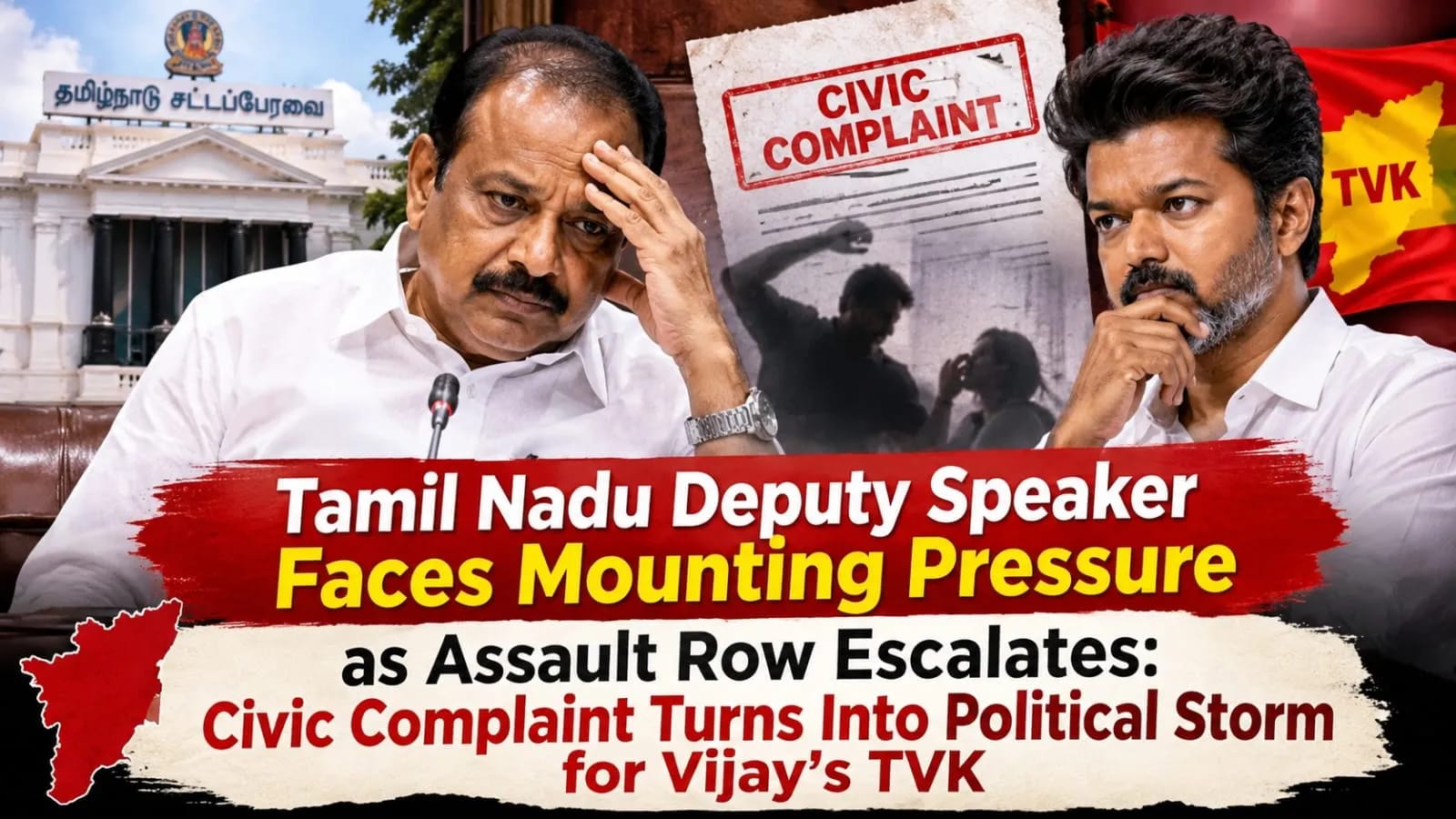
Tamil Nadu Deputy Speaker Faces Mounting Pressure as Assault Row Escalates: Civic Complaint Turns Into Political Storm for Vijay's TVK
A controversy involving Tamil Nadu Deputy Speaker and TVK Thuraiyur MLA M. Ravi Shankar has developed into a major political challenge for Chief Minister Vijay's government. What began as a citizen's complaint over drinking water shortages and garbage accumulation has escalated into allegations of physical assault, police intimidation and an attempt to silence the complainant. The incident has raised serious questions about the conduct of elected representatives and the accountability of the new ruling party.
By C Sunil Kumar • 10 views